Every robot needs 30 magnets. There aren’t enough.
A senior member of Katusa Research just got back from a trip to Austin, Texas.
Between the robot barista at the layover San Francisco airport, to the Waymo self-driving car, and the food delivery robot…

Things in society are coming to you and I fast. The rise of the robots isn’t a far-off reality anymore if that trip is any indication… It’s already here.
Now, most people couldn’t pick it out of a periodic table…
But this rare earth metal has become one of the key chokepoints in the race to build humanoid robots.
- Neodymium is up 113% in twelve months.
The price action over the past year says the market is starting to catch on.
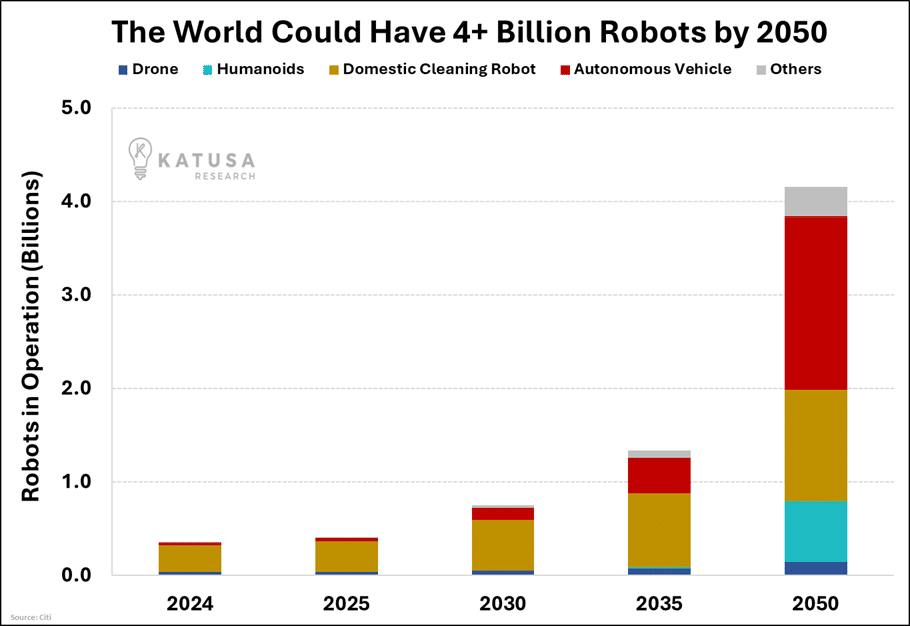
Citi projects 1.3 billion robots in operation by 2035. Four billion by 2050.
By 2035, 60% of all robots will be domestic cleaning robots, roughly one for every three households on earth.
Tesla plans to start selling humanoid units in 2027, targeting one million per year.
Chinese manufacturers like Unitree Robotics and Fourier Intelligence are racing to match that pace.
The 30-Motor Problem
A single humanoid robot needs 30 or more motors, each powered by rare earth magnets called NdFeB (neodymium-iron-boron).
No current alternative matches their power density.
Ryan Castilloux, managing director of Adamas Intelligence, puts the math bluntly: hitting Musk’s goal of 10 billion robots by 2040 would need more than 100 times current global NdFeB magnet output.
Even the low end breaks the math.
One billion robots by mid-century (Morgan Stanley’s figure) would eat 1.6 million metric tons of copper per year.
- That’s 6% of today’s global copper demand, added to a supply chain already under strain.
NdPr oxide is the key rare earth input for robot magnets. It nearly doubled from $60,000/kg last July to over $120,000/kg by early 2026.
BMI, a Fitch company, says the NdPr market will run a deficit for the second straight year in 2026 as EV motors, wind power, and robots all chase the same material.
Copper’s 10 Million Tonne Hole
Rare earths grab headlines, but copper may be the bigger constraint.
An S&P Global study from January found that global copper demand will hit 42 million metric tons by 2040, a 50% jump from today. Supply, even with a doubling of recycled scrap, will fall 10 million metric tons short.
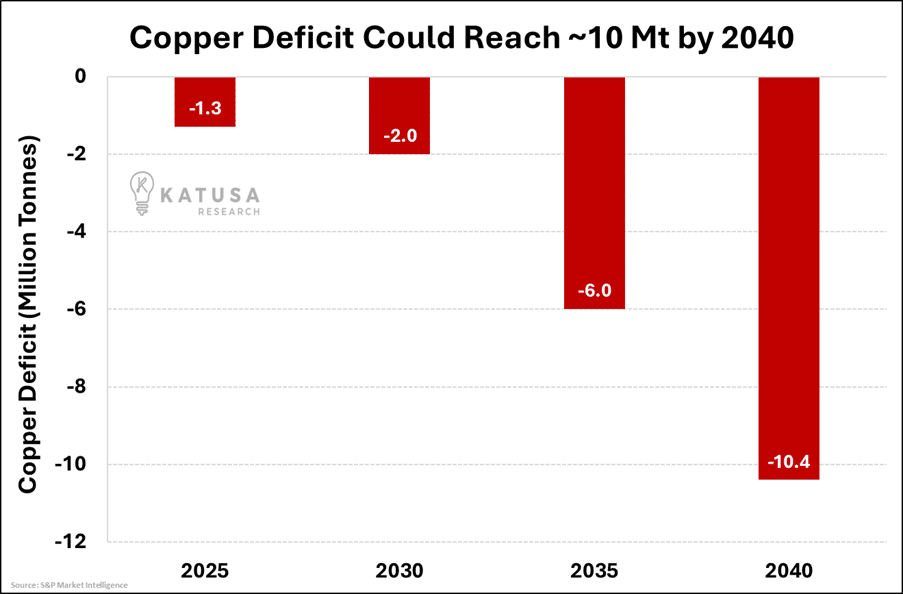
S&P called it a “systemic risk” for global industry.
And that deficit exists before robots.
- With robots factored in, S&P estimates 1.6 to 16.5 million metric tons of additional annual demand, depending on adoption scale.
Copper hit $13,000 per metric ton in early 2026, a record. Global output is set to peak in 2030 at 33 million metric tons, then fall as ore grades drop and costs rise.
New mines take 17.9 years on average from find to first output.
The fix for today’s gap won’t show up until the 2040s.
Lithium’s Role in Robotics
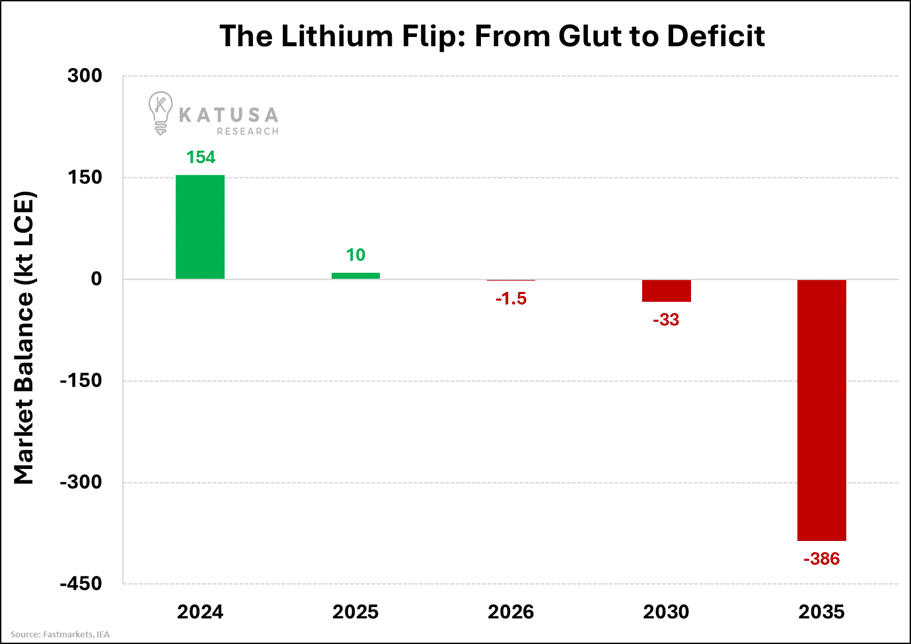
Lithium looks like the one metal with room to breathe. The market ran a surplus of 175,000 tonnes in 2023 and 141,000 in 2025, per S&P Global.
Prices hit four-year lows. Headlines declared the lithium boom dead.
That surplus is shrinking.
S&P projects 109,000 tonnes in 2026, while Fastmarkets forecasts the market flips into a 1,500-tonne deficit by year-end.
Prices already rebounded 56% in H2 2025, climbing from $10,800/mt to $16,900/mt by December.
The price crash did real damage to future supply.
- Arcadium Lithium and Core Lithium shut down mines in Australia.
- Albemarle paused its global growth plan.
In August 2025, CATL halted its Jianxiawo mine in Jiangxi province after a permit expired.
That single site held 3-6% of global lithium supply. And when the news broke, Albemarle jumped 17%, Pilbara 16%, and lithium futures hit the daily limit on the Guangzhou exchange.
The pipeline got gutted during the exact window when future demand was compounding.
- Citi projects that 1.3 billion AI robots will be operational by 2035, increasing to 4 billion by 2050.
Re-read that.
Scaling to Musk’s 10-billion-unit projection and Adamas Intelligence says you’d need 10 times current global lithium production just for robots.
The IEA projects lithium demand from clean energy will grow 5x by 2040. That model was built before robots entered the picture.
Every bump in robot forecasts is a bump in lithium demand that most supply models haven’t priced in.
85% Of Refining Runs Through One Country
China controls roughly 85% of global rare earth refining and 40-50% of copper smelting.
When MP Materials, the only active rare earth miner in the U.S., stopped shipping raw ore to China last year, NdPr oxide prices jumped 40% in weeks.
One company’s supply shift moved a global market. Now, western governments are spending to close the gap.
The DOE put $1 billion toward rare earth supply chains. MP Materials is expanding Mountain Pass in California.
The EU passed its Critical Raw Materials Act. But Mountain Pass has been “expanding” since 2022, and the average new mine takes 18 years to reach output.
Policy and physical production run on very different clocks.
Three Metals, One Math Problem
Neodymium is up 113% in a year.
Copper is at all-time highs with a 10-million-ton projected deficit.
Lithium’s surplus is evaporating just as a new demand source enters the picture that most supply models haven’t accounted for.
- These three supply gaps share the same root cause: demand from robots, EVs, grid storage, wind, defense, and AI is scaling all at once.
The mines needed to feed that demand were never built when they should have been.
The companies on the right side of these gaps — with permits in hand, production growing, and costs locked below spot…
Are the ones we’ve been building positions in for the past two years inside Katusa’s Resource Opportunities.
Each one was picked using Katusa’s framework for telling which miners actually gain from supply crunches and which ones just talk about them.
Regards,
Marin Katusa
Get real-time alerts right away. Follow on X: @KatusaResearch and @MarinKatusa
Details and Disclosures
Investing can have large potential rewards, but it can also have large potential risks. You must be aware of the risks and be willing to accept them in order to invest in financial instruments, including stocks, options, and futures. Katusa Research makes every best effort in adhering to publishing exemptions and securities laws.
By reading this, you agree to all of the following: You understand this to be an expression of opinions and NOT professional advice. You are solely responsible for the use of any content and hold Katusa Research, and all partners, members, and affiliates harmless in any event or claim.
If you purchase anything through a link in this email, you should assume that we have an affiliate relationship with the company providing the product or service that you purchase, and that we will be paid in some way. We recommend that you do your own independent research before purchasing anything.