You’re not late. The frenzy hasn’t started.
Gold just posted its worst month since 2008. Silver gave back a third of its value from the January highs.
If you own resource stocks, March felt like the market was trying to tell you something… that the bull run you finally believed in had already ended.
- But price doesn’t tell you where the cycle is.
- It tells you where the emotion is.
And there’s a scoreboard for the cycle that nobody knows how to check.
It’s one that was flashing a very specific signal in the weeks before this correction even started.
Where’s the garbage?
Every resource (and sector) bull market in the last 40 years ends the same way.
New companies flood the exchanges with fresh paper. Promoters dust off claims nobody wanted when copper was $3 and silver was an afterthought. Geologists who spent the bear market consulting start staking ground on weekends.
The TSX Venture Exchange fills with fresh tickers attached to little more than a PowerPoint, a property map, and a prayer.
The industry calls it moose pasture, and it means land that’s worth more to the moose than the shareholders. And moose pasture has a near-perfect record as a cycle-top indicator.
So where is it?
Six Billion Dollars and Only 4 New Faces
Canadian mining companies raised $6.7 billion in January and February of 2026.
- That’s more than four times the same window three years ago,
- And more than double last year’s pace (401 separate financings in just two months).
That money was committed before Iran, before $115 oil, before gold’s 18% drawdown.
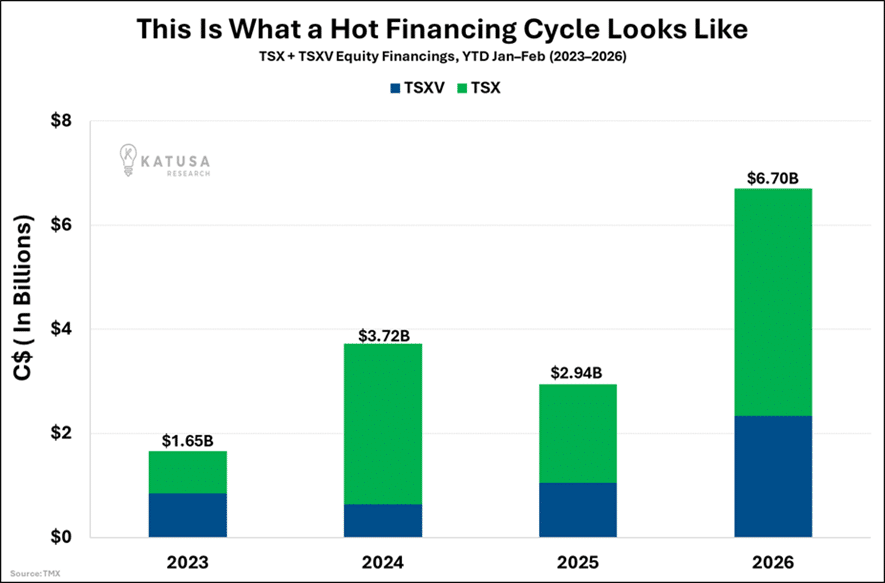
Almost all of that money went to companies that already existed, with projects that already had drill results and development timelines.
So far this year, only 4 companies went public on the Venture Exchange, while $6.7 billion flowed into the sector around them.
In my experience, that’s not a tell-tale sign of a gold rush or bull market top.
Read the Check, not the Chart
Instead, I’m seeing institutional and HNW capital making calculated bets on de-risked assets and ignoring everything else.
I can say that in my office, I’m doing the same.
The average deal size confirms who’s writing the cheques.
- In 2024, the typical financing raised $3 million.
- Today, the average is $8.3 million.
That nearly threefold jump doesn’t mean more investors showed up.
It means bigger investors showed up: fund managers who’ve walked the core shack, stress-tested the 43-101, and modelled the economics at three different metal prices before wiring a dollar.
I call this the Cheque-Size Signal — and it may be the single most useful diagnostic for separating a mid-cycle correction from a cycle top.
When the average cheque is growing, institutional money is accumulating with conviction.
When it starts shrinking, the institutions are liquidating while retail investors arrive with excitement and smaller wallets.
The Pasture Is Still Frozen
I call this the Moose Pasture Test, and right now the market is passing it cleanly.
When secondary financings dominate and new listings stay flat, institutional money is re-underwriting known assets at higher conviction.
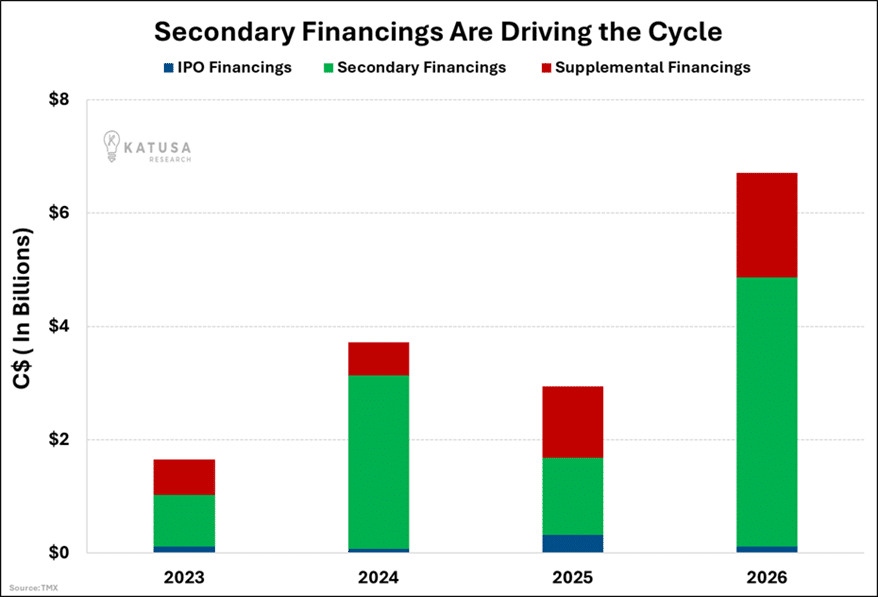
That’s what mid-cycle looks like…
The money is serious, the deals are real, and the companies getting funded have actual projects with actual mine plans.
When new listings explode and average deal sizes start shrinking, the institutions are heading for the exits while retail arrives with both hands open. The cheques get smaller because the cheque-writers get less sophisticated.
That’s the cycle-top signal that has preceded every major resource correction in modern Canadian markets.
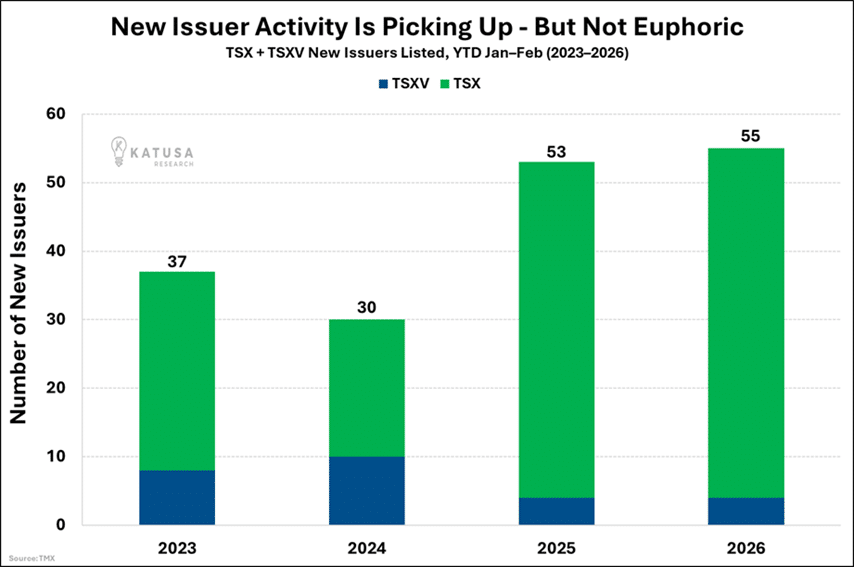
Right now, the capital is overwhelmingly flowing into TSX-listed companies (in green).
- The hot money that funds anything with a pulse hasn’t arrived.
The promoters who can smell easy capital from three provinces or states away haven’t started filing prospectuses. The moose pasture is still frozen solid.
And in resource investing, frozen pasture means the cycle has room to run.
By early 2011, the TSXV had swollen to over 1,200 mining and exploration companies, with new listings flooding in every week. Many were attached to properties that nobody would have touched two years earlier.
The collective market cap hit $45 billion, and everyone in Vancouver had a stock tip for the cab driver.
Then the exchange lost 82% of its value over the next four years, a destruction of capital that wiped out nearly every late-cycle entrant. The moose pasture promoters disappeared, the retail cheques stopped clearing and the institutions had already left.
That’s the movie, and every experienced resource investor recognizes the characters.
But right now, it’s playing in reverse: cheque sizes are growing, not shrinking.
New listings are flat, not flooding the market like at market tops.
While the crowd watches the gold price bounce, the deals are getting done.
- This past month, we published on a pre-IPO financing in Katusa’s Resource Opportunities, my premium research service.
It’s a legendary North American gold district that’s been locked behind closed doors for over a century, now consolidated under one roof for the first time.
KRO subscribers got alerted to it well before it trades on any exchange.
That’s what being in the room looks like.
Regards,
Marin Katusa
Get real-time alerts right away. Follow on X: @KatusaResearch and @MarinKatusa
Details and Disclosures
Investing can have large potential rewards, but it can also have large potential risks. You must be aware of the risks and be willing to accept them in order to invest in financial instruments, including stocks, options, and futures. Katusa Research makes every best effort in adhering to publishing exemptions and securities laws.
By reading this, you agree to all of the following: You understand this to be an expression of opinions and NOT professional advice. You are solely responsible for the use of any content and hold Katusa Research, and all partners, members, and affiliates harmless in any event or claim.
If you purchase anything through a link in this email, you should assume that we have an affiliate relationship with the company providing the product or service that you purchase, and that we will be paid in some way. We recommend that you do your own independent research before purchasing anything.