

Your hand has been hovering over the sell button.
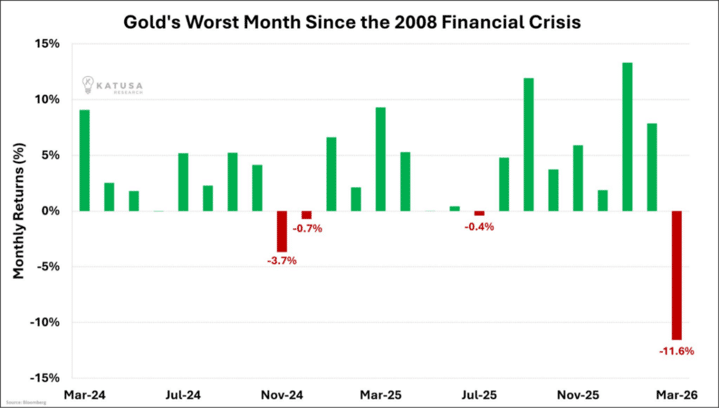
Gold just closed out its worst month since August 2008 — down 11.6%.
Ninety-five percent of GDX mining stocks are in bear-market territory, up from five percent four weeks ago.
The friends who laughed at your gold position eighteen months ago are having a very good week.
In the back of your head, a question forms…
The one every gold investor asks at this point in every cycle: what if they were right and you were wrong? Your gut remembers the wrong history.
The history it should remember is the reason you bought gold in the first place.
Remember This 2008 Part?
The last month gold had that look like March 2026 was back in August 2008.
Gold ran from $250 to $1,003, the crowd had finally been convinced, and then Lehman collapsed. The financial system tried to liquidate everything it owned into cash.
Within months, the price collapsed to $712, a 30% crater that erased eight years of patience in a single stroke.
The obituaries were immediate. Gold was broken, it wasn’t a hedge anymore, it had failed the one test it was supposed to pass. Sell before it got worse.
What most forget is what came after the capitulation.
Within months, gold bottomed.
Three years later it was trading at $1,900 — a new all-time high, 167% above the low, and the largest three-year move of the entire 2000s bull market.
Every investor who sold in October 2008 watched that move from the sidelines.
And 2008 was not even the most dramatic version of the pattern.
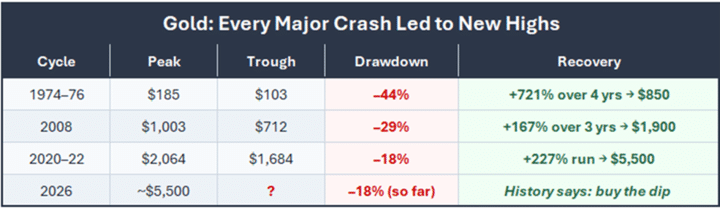
The current ~18% drawdown is the next row in that table.
The Data Doesn’t Make This a Close Call…
We can track extreme gold washouts with simple backtests.
These are moments when investor pessimism gets as stretched as it is right now.
We can look at nine historical instances over the last twenty years. Eight of those nine rolled higher one year later, for an 89% win rate and a median one-year return of 10.1%.
On those setups, gains of +10% were roughly four times more likely than losses of 10%+.
Narrow the filter to the exact condition we are in right now… with GLD more than 18% below its 52-week high and the signal gets louder.
- Five prior instances happened since 2006, and every one of them was higher a year later.
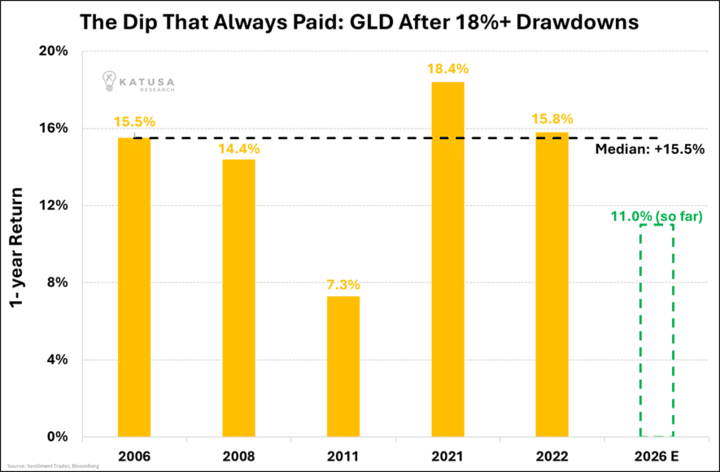
The results are a median one-year return of 15.5%.
A sample of five is not a promise. But that asymmetry is what serious investors build careers on, not what they get scared out of by just one red month.
The math hasn’t been on the side of the sellers at this point in the cycle. Nor in any of the five prior instances.
And there is no structural reason this one should be the first.
The Scare of Drawdowns Continues With the Miners (GDX)
Over the last 14 years, there’s another signal that flashed 4 times in the GDX. And the index has given amazing returns in the months to follow.
The same signal flashed again last month.
When over 95% of miners in GDX are in bear market territory, GDX’s median return over three months is 21.8%.
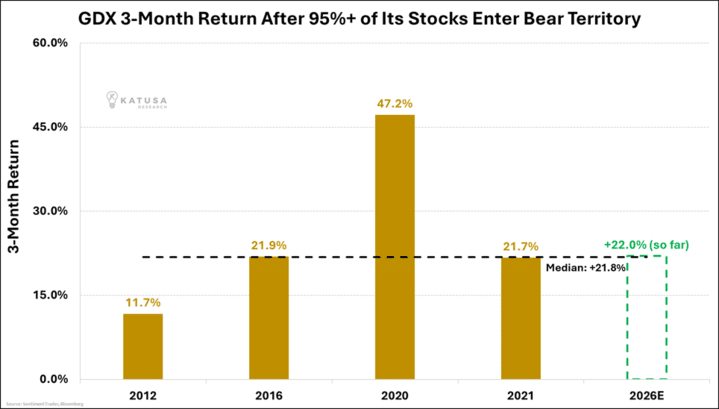
Since the last signal, GDX is already up 22%.
What’s Different This Time
Every previous Funeral Phase resumed because a structural thesis survived the capitulation.
The 1970s had inflation and Bretton Woods. 2008 had the financial crisis and the first round of QE. 2020–22 had COVID stimulus and peacetime debt expansion at a historic scale.
This cycle has something the others didn’t.
- Tether: The largest stablecoin on earth, a token now settling more daily volume than Visa — is buying physical gold to back its reserves.
That’s a sentence that did not exist in any prior gold bull market.
Central banks are accumulating at a record pace on top of it, and sovereign debt is expanding faster than any fiat can absorb.
The structural bid for gold is wider and more indifferent to retail sentiment than ever.
The Funeral Phase does not care about the headlines because the buyers who matter don’t watch CNBC.
Why do these corrections still work on sophisticated investors?
Memory is short and emotional.
What comes to mind is last month, when the account was bigger. It’s the physical sensation of watching a position turn on you, and the friend who will mention this, unprompted, at the next dinner.
The history in the table above is the useful one.
- Every generation of gold investors has faced this moment, and the ones who sold at the bottom paid for it for years — sometimes for the rest of their careers.
Gold might go lower from here. Bases form over weeks, not days.
But lower is not broken, and a drawdown is not a thesis.
The thesis would be that central banks stop buying, Tether stops accumulating, and sovereign debt starts shrinking.
None of those things has happened.
Gold does not need you to believe in it. It needs you to outlast the people who don’t.
Every investor who built real wealth in gold stared at a number like the one on your screen, read headlines like the ones in your feed, and had the same argument with his own gut that you are having with yours.
The ones who sold in 1975 paid for it until 1980.
The ones who sold in October 2008 watched the largest three-year move of the decade without them.
The ones who sold in 2022 missed the run to $5,500.
If you didn’t take profits and Katusa free rides a few months ago like we published to members, we were doing in Katusa’s Resource Opportunities…
Put your hand down.
The sell button will still be there tomorrow.
— Marin Katusa
Get real-time alerts right away. Follow on X: @KatusaResearch and @MarinKatusa
Details and Disclosures
Investing can have large potential rewards, but it can also have large potential risks. You must be aware of the risks and be willing to accept them in order to invest in financial instruments, including stocks, options, and futures. Katusa Research makes every best effort in adhering to publishing exemptions and securities laws.
By reading this, you agree to all of the following: You understand this to be an expression of opinions and NOT professional advice. You are solely responsible for the use of any content and hold Katusa Research, and all partners, members, and affiliates harmless in any event or claim.
If you purchase anything through a link in this email, you should assume that we have an affiliate relationship with the company providing the product or service that you purchase, and that we will be paid in some way. We recommend that you do your own independent research before purchasing anything.