Gold’s Marketing Budget
Every dollar of Washington’s interest bill is an argument for gold.

You probably believe gold goes up when the debt goes up.
This year should have cured you of it, because Federal debt crossed $40 trillion in August.
Gold spent the same eight months falling 28%, from a $5,597 record in January to $3,976 this summer.
If the debt story were a formula, that couldn’t have happened.
Net interest on the federal debt will cost $1.04 trillion in fiscal 2026. That’s more than national defense, more than Medicaid.
- Five years ago interest was six cents of every federal dollar. Now it’s fifteen.
It used to be a problem for your grandchildren and now it’s a line item in this year’s budget.
In May, I told Katusa’s Resource Opportunities readers that Washington would step into the bond market to hold the long end down the moment it hurt, and that it wouldn’t need the Fed’s permission to do it.
On August 19, the 30-year hit 5.34% (the highest since 2007), and Treasury doubled its buybacks of long bonds the same day. The dollar slipped and gold rose 4% in a session.
Gold doesn’t go up because the U.S. interest bill goes up.
Gold goes up when the rising interest bill becomes a confidence problem.
The U.S. Interest Bill Became Gold’s Marketing Budget…
What moved gold this year was rate expectations.
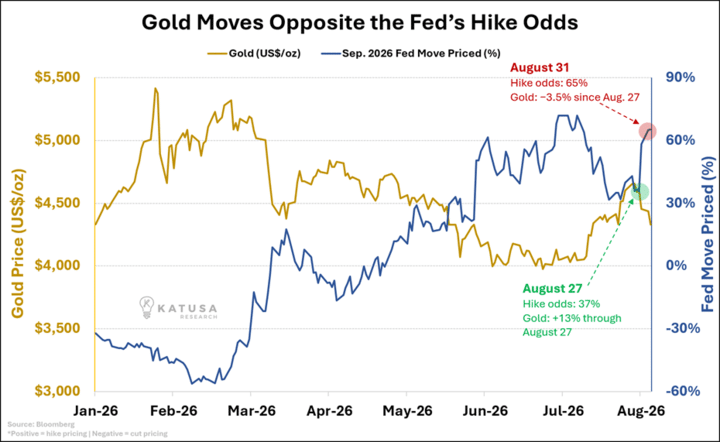
The Iran war pushed oil up, oil pushed inflation up, and by late July the market priced a 72% chance the Fed would hike in September.
Gold pays nothing, so every tick higher in hike odds raised the cost of holding it. Gold sold off, exactly as it should have.
Then two things broke that trade.
- On August 7, the jobs report showed the economy lost 23,000 jobs in July.
- Twelve days later, Treasury stepped in.
Hike odds were 37% as of August 27, and gold was up 13% on the month.
Four days later, the trade ran in reverse. Hike odds jumped back to 65%, and gold fell 3.5% from its August 27 close.
That reversal confirms the split: the Fed controls gold’s next move, while Washington’s balance sheet shapes the longer trend.
Washington Pens the Ads
Every year Washington spends more just to service what it owes.
And every year that number reminds everyone who holds dollars what the currency is backed by: a balance sheet that gets harder to finance.
The average rate on the debt is 3.4%, the highest since 2009, and it’s still climbing as old bonds roll into new ones.
The Congressional Budget Office has net interest reaching $2.1 trillion by 2036.
- Interest already takes about 20 cents of every dollar of federal revenue, and the Concord Coalition expects 30 cents within the decade.
Nobody in Washington has put forward a plan to change that, and the S&P piece says so plainly.
That’s the marketing budget.
It runs every year, it grows every year, and gold doesn’t pay a dime for it.
Here’s what sixteen years of that advertising bought…
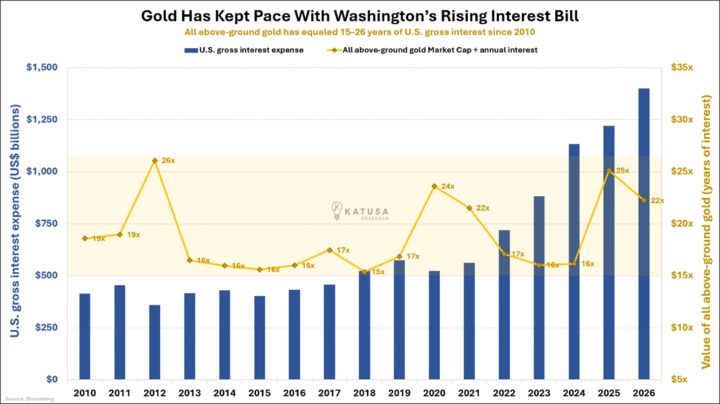
Since 2010 the gross interest bill – the full amount Treasury pays including to its own trust funds – has more than tripled to about $1.4 trillion a year.
The value of all the gold ever mined has gone from $7.6 trillion to about $31 trillion.
- Through all of it, gold has been worth somewhere between 15 and 26 years of U.S. interest.
It’s 22 years today.
The next time someone tells you it’s in a bubble, ask what happened to the interest bill.
Gold Caught Up
But the miners still have to earn it.
The market doesn’t price a gold miner on the gold price. It prices it on what the board does with the money… and the boards have a record.
We know Washington will spend about $1.039 trillion on net interest this fiscal year, about $2.85 billion a day.
Let’s set that against what the gold industry is actually worth…
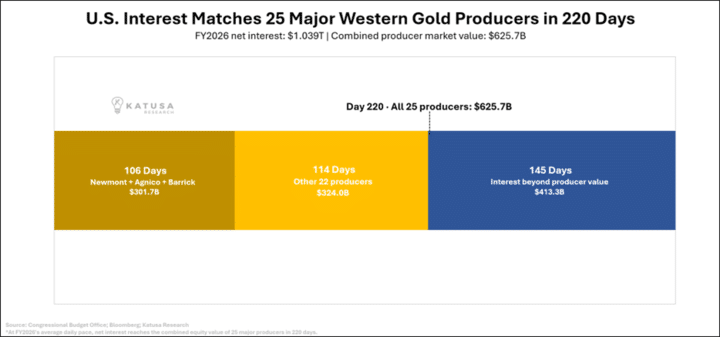
I screened 25 companies for the September KRO, every Western producer above 250,000 ounces a year. Together they’re worth $626 billion, which is 220 days of Washington’s interest bill.
Newmont, Agnico Eagle and Barrick, the three biggest gold miners in the Western world, account for 106 of those days between them.
Cheap, on the numbers.
One year of net interest could buy all of them and have close to $400 billion left over.
Those 25 producers are clearing roughly $2,900 an ounce at $4,600. That’s the problem, because that margin is exactly what makes boards do foolish things.
- The last time it looked like this, in 2011, the industry spent it buying the top and wrote off $9.4 billion inside three years.
The market remembers.
Gold benefits from a government that pays a trillion dollars a year in interest. The producers only benefit if their boards don’t spend the windfall the way they did last time. Some of them have learned but most of them haven’t.
Sorting the two is the entire job.
Every one of these boards is about to be handed more cash than they’ve seen since 2011, and the spending decisions get made this cycle.
Regards,
Marin Katusa
P.S. Barrick is about to IPO the best gold assets in North America, into the highest prices in history. One question matters: is that a board that learned, or a board cashing out before you figure it out? Our answer is in the issue.
Get real-time alerts right away. Follow on X: @KatusaResearch and @MarinKatusa
Details and Disclosures
Investing can have large potential rewards, but it can also have large potential risks. You must be aware of the risks and be willing to accept them in order to invest in financial instruments, including stocks, options, and futures. Katusa Research makes every best effort in adhering to publishing exemptions and securities laws.
By reading this, you agree to all of the following: You understand this to be an expression of opinions and NOT professional advice. You are solely responsible for the use of any content and hold Katusa Research, and all partners, members, and affiliates harmless in any event or claim.
If you purchase anything through a link in this email, you should assume that we have an affiliate relationship with the company providing the product or service that you purchase, and that we will be paid in some way. We recommend that you do your own independent research before purchasing anything.
This is an expression of opinion and not professional advice. Neither Marin Katusa nor Katusa Research are registered broker-dealers or financial advisors. Past performance is not indicative of future results. When investing in speculative stocks, it is possible to lose your entire investment.
© 2026 Katusa Research / New Era Publishing Inc.