Missing Escondida
The second-largest copper mine on earth has never shipped a pound.
Somewhere in your portfolio sits a copper forecast you have never read.
Your index fund owns it through the biggest producers, BHP and Freeport. And your pension owns it through the analyst who models them.
Every one of them opens with the same instruction: subtract 5%.
Copper set an all-time high above US$6.80 a pound on the Comex this week.
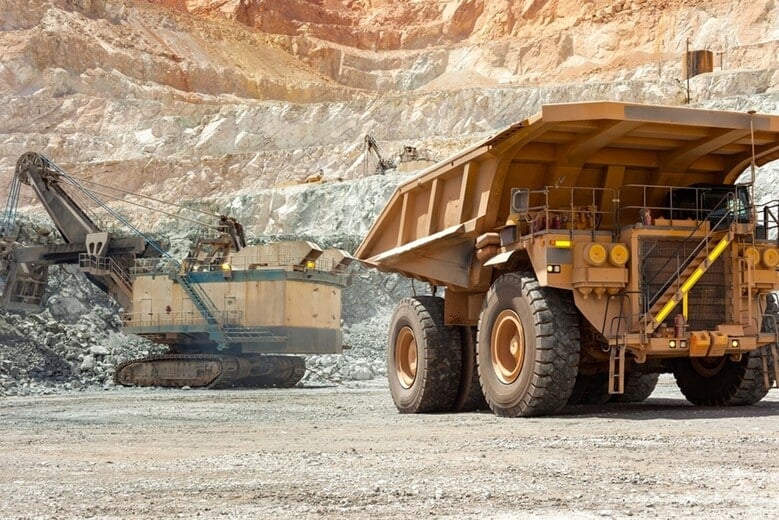
The largest copper mine on earth is BHP’s Escondida in Chile’s Atacama Desert. It produced 1,261,000 tonnes in the year to June (about 2.8 billion pounds).
At this week’s price, that metal is worth about US$19 billion.
The second-largest copper mine on earth produces nothing.
It lives inside every analyst’s spreadsheet.
Wood Mackenzie assumes the world loses about 5% of planned copper output every year before a single truck moves.
On roughly 23.4 million tonnes of annual mine supply, that’s about 1.17 million tonnes.
- Every January the copper industry writes off a mine the size of Escondida before the first truck moves.
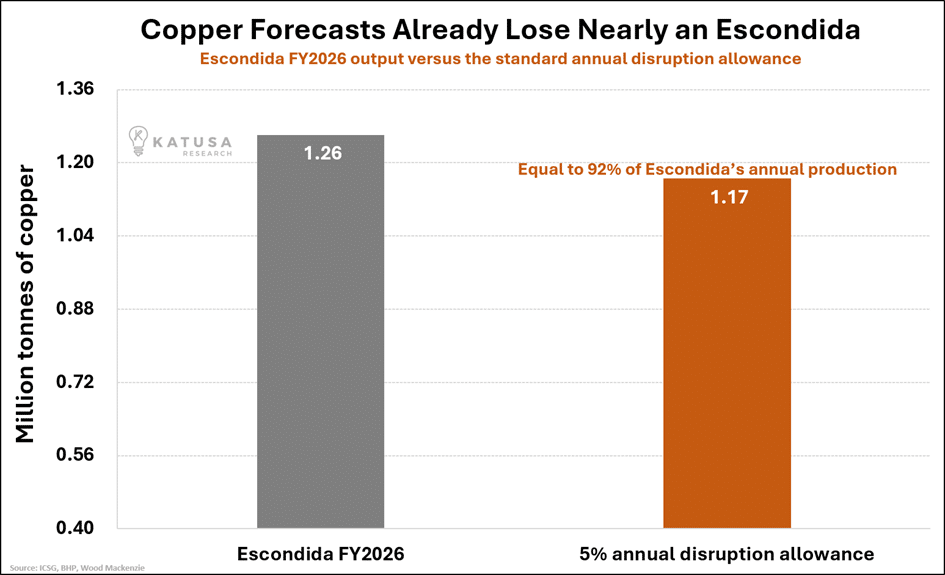
That line item is the Missing Escondida, the copper the industry plans to lose from a mine nobody built.
And at this week’s price it is worth more than US$17 billion.
Losing a Mine Without Closing One
I’ve spent more than twenty years walking pits, and every visit starts with the same question: what can stop this mine? In 2026, it arrived from every direction a mine can be hit.
Weather:
Two winter storms hit northern Chile in July and August. Antofagasta cut Los Pelambres guidance by up to 45,000 tonnes, Lundin cut Caserones by 10,000, and Chile’s July copper output fell 9.4%.
Strikes:
Workers at Capstone’s Mantoverde cut off its water for weeks in January. Even Escondida went missing for 44 days in 2017.
Accidents:
Codelco’s El Teniente will run below plan for five years after its 2025 tunnel collapse.
Courts and communities:
A Brazilian judge suspended every licence at Sigma Lithium’s Grota do Cirilo, about 60% of Brazil’s lithium. Sigma is still mining and in court. Its shares fell about12% anyway.
Governments:
China revoked the permit at CATL’s Jianxiawo, about 4% of world lithium, five weeks after it restarted, and in May stopped exporting the sulphuric acid that leaches about 15% of world copper. Congo capped cobalt and restricted copper-concentrate exports.
Why the Tonnes Don’t Come Back
When a mine stops, the copper it fails to sell is the cheap part. Three bills arrive, and as a shareholder you pay all of them.
The first bill lands on mines that stay open.
Caserones will produce 7.4% less than planned, and its cash cost guidance rose 4.7% to US$2.25 a pound.
The second bill never stops.
BHP’s Western Australia Nickel produced 81,600 tonnes in the year to June 2024, nothing two years later, and still lost US$255 million. Keeping the pumps and fans running costs about US$300 million a year.
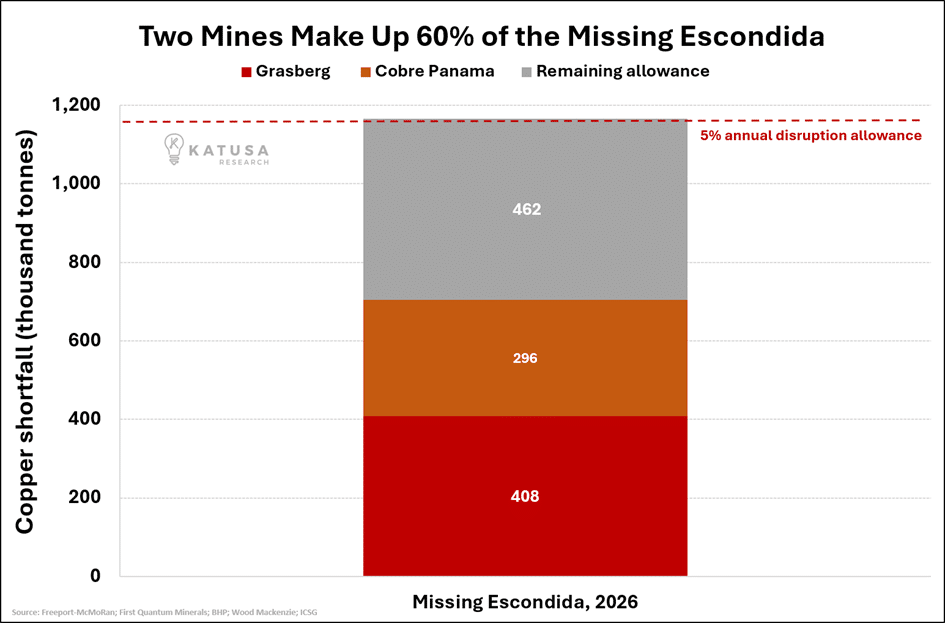
First Quantum has paid about US$15 million a month since November 2023 to keep Cobre Panamá safe.
The mine produced 330,863 tonnes in 2023 and will produce 30,000-40,000 this year.
- Add Grasberg’s 408,000-tonne shortfall, and the two mines together eat 60% of this year’s allowance.
The third bill is time…
Core Lithium shut Finniss in January 2024. With A$290 million of new money, full output returns in mid-2028. Its tonnes never left the supply forecasts.
The Allowance Is Growing
World mine capacity grew 3.8% in the first half of 2026 while output fell 1.1%, per the International Copper Study Group.
About 573,000 tonnes of built capacity produced nothing.
Over a full year, that’s a Missing Escondida of its own.
Wood Mackenzie says the allowance may need to rise from 5% to 6%, another 250,000-300,000 tonnes a year, more than US$4 billion at this week’s price before anyone has dug anything.
- S&P Global says a new US mine now takes nearly 29 years on average from discovery to production.
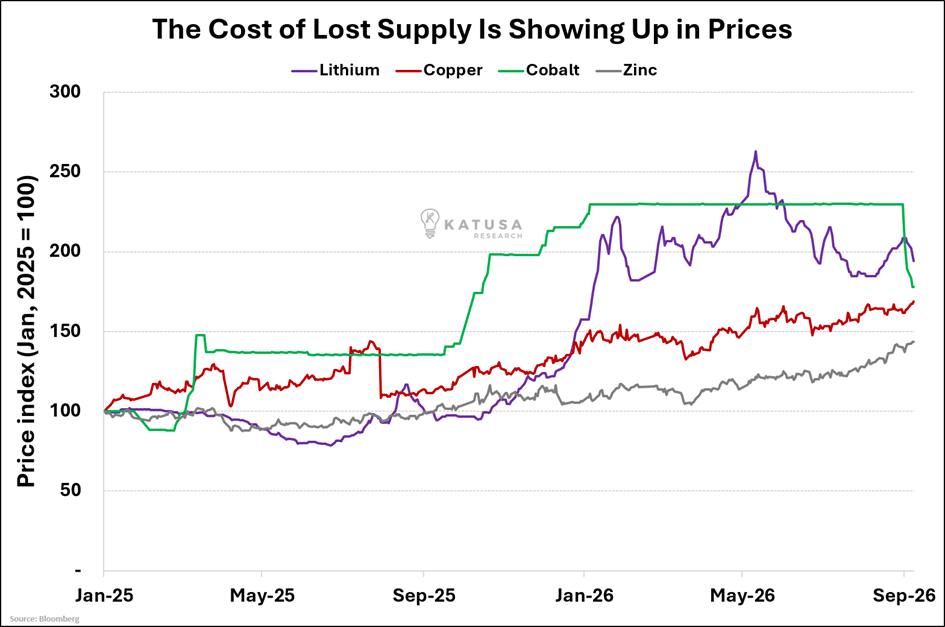
Zinc touched a four-year high this week at US$1.83 a pound, while cobalt stands about 80% above January 2025.
Copper is most talked about, but this pattern runs across mined metals.
The Mine That Kept Running
When a mine goes missing, its copper doesn’t vanish.
The buyer still needs it. And the price goes up, and the order goes to a mine that’s still running.
That’s why a boring mine in a boring place makes the best money in a year like this one.
Boring, to me, is five things…
- The mine has its own power line and a backup.
- It controls its own water.
- It has more than one pit, so one bad wall does not stop the mill.
- Its workers signed a contract that runs past the next election.
- And the company owns more than one mine, because one judge shut Sigma’s only mine and took 15% off the stock before the market opened.
A shut mine that promises to “come back when prices recover” needs two things before I believe it: new money and about two more years.
Go through the copper stocks you own and ask those questions of each one.
Most will fail at least one.
Finding the ones that pass is what Katusa’s Resource Opportunities is for. Members see the companies that clear this list and the ones I own myself.
The mine nobody built has never flooded or lost a wall, and its workers have never struck, yet it grows every year.
Real mines keep going missing, so own the ones that stay open.
Regards,
Marin Katusa
Get real-time alerts right away. Follow on X: @KatusaResearch and @MarinKatusa
Details and Disclosures
Investing can have large potential rewards, but it can also have large potential risks. You must be aware of the risks and be willing to accept them in order to invest in financial instruments, including stocks, options, and futures. Katusa Research makes every best effort in adhering to publishing exemptions and securities laws.
By reading this, you agree to all of the following: You understand this to be an expression of opinions and NOT professional advice. You are solely responsible for the use of any content and hold Katusa Research, and all partners, members, and affiliates harmless in any event or claim.
If you purchase anything through a link in this email, you should assume that we have an affiliate relationship with the company providing the product or service that you purchase, and that we will be paid in some way. We recommend that you do your own independent research before purchasing anything.
This is an expression of opinion and not professional advice. Neither Marin Katusa nor Katusa Research are registered broker-dealers or financial advisors. Past performance is not indicative of future results. When investing in speculative stocks, it is possible to lose your entire investment.
© 2026 Katusa Research / New Era Publishing Inc.