Three days left
Of copper outside America. Then what?

Open your fridge and count the days of food inside.
Most homes hold about a week. Now run the same count on the world’s copper.
Outside American warehouses, the answer is three days.
Three.
The number you’ll see quoted is the global total, and the global total is doing something dishonest.
The world’s visible copper sits in three warehouse systems: COMEX in the United States, the LME serving Europe and Asia, and Shanghai inside China. Add them up and the total looks survivable.
The total is hiding a migration.
America Started Hoarding
When Washington floated copper tariffs, copper started moving, and it hasn’t stopped. Traders shipped copper into American warehouses to beat the deadline and capture the premium.
Since the combined stockpile peaked on March 20, the three systems together have drained about 30%.
The drain played favorites. COMEX inventories grew 25% while the LME fell 40%.
Shanghai collapsed 85%.
The metal is leaving the places that use it and parking in the place that taxed it. America is hoarding, and the global number wears the hoard as camouflage.
Three Days on the Clock
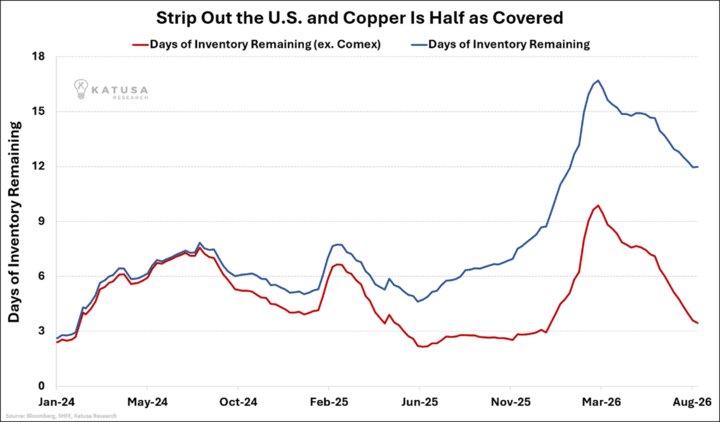
Measure inventory the way a family measures food: in days.
The world’s visible copper now covers about 12 days of demand, down from almost 17 in March.
- Strip out the American stockpile, and the rest of the planet holds just over three days, down from nearly ten.
Three days leaves no room for a strike, a smelter outage, or a slow ship. The world outside America is living paycheck to paycheck on the metal that carries its electricity.
And buyers can feel it.
Requests to pull copper out of LME warehouses in Asia have jumped to 100,675 tonnes, four times the long-term average. Requests don’t always turn into withdrawals, but every one is a buyer trying to lock metal down before someone else does.
On Monday, the panic got a price tag.
Buyers paid $545 a tonne over the three-month futures contract, the widest gap since the 2021 squeeze. Shorts paid $110 a tonne to survive a single day, because delivery day lands Wednesday and they owed metal that barely exists.
Trafigura poured its own copper into LME warehouses to calm the market and the gap still held near $250.
Smelters Now Pay the Miners
The shortage shows up one step earlier too, before copper ever reaches a warehouse.
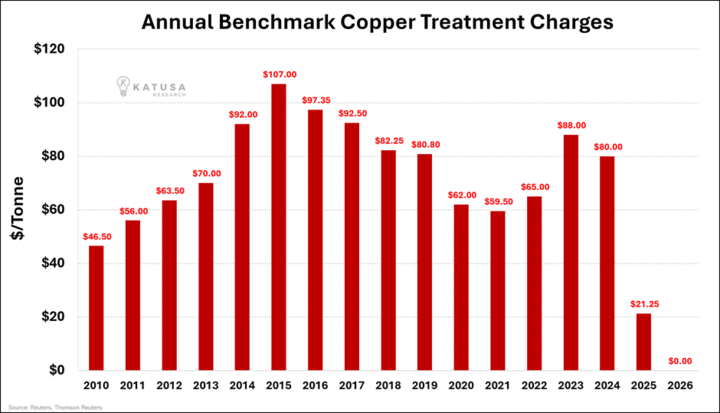
Most mines never sell finished copper. They sell concentrate, a powder about one-quarter copper, and smelters charge a fee to turn it into metal. That fee is a live reading on how much mine supply exists. Plenty of concentrate, high fee. Scarce concentrate, and smelters cut their price to win every tonne.
In 2015, the benchmark fee sat at $107 a tonne. By 2024, it had fallen to $80, and last year it hit $21.
This year it hit zero, the lowest on record. And in the spot market the fee has gone negative: some smelters now pay miners just to keep their furnaces fed.
By June, the spot fee sat at negative $127 a tonne.
- Twenty-five years around this market, and I’ve never watched that benchmark print zero until now.
It means the machines that make copper are fighting over the rock that feeds them. The warehouses show the shortage in finished metal. The smelters show the same shortage at the mine gate.
The Hole Gets Wider
Three days is this year’s problem. The next twenty years make it structural.
In 1882, Thomas Edison wired Pearl Street Station to a handful of buildings in lower Manhattan, and the modern grid started on a red metal wire.
A hundred and forty-four years later, everything new still hangs on that same wire: the grids, the electric cars, the solar farms, the data centers, the defense buildout.
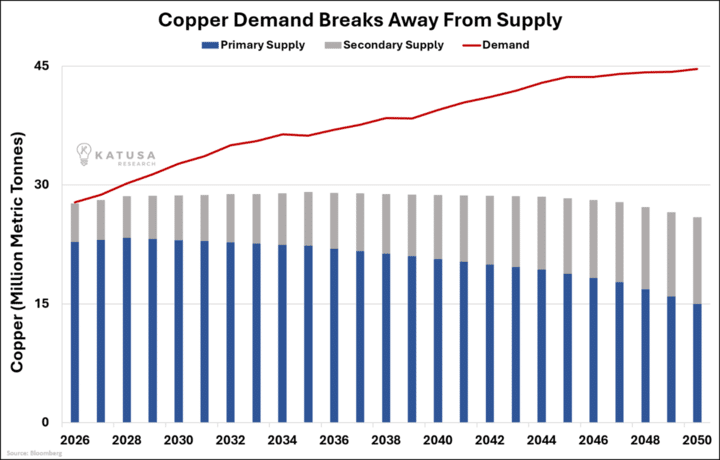
Bloomberg’s long-run math says the pull reaches 44.7 million tonnes a year by 2050.
Today’s mines can’t meet it.
Because today’s mines are shrinking.
- As ore grades thin, output from existing operations falls from 22.7 million tonnes to 15.
- Recycling doubles and still leaves the world short 18.7 million tonnes a year.
That difference is nearly the size of today’s entire mined supply. And supply can’t sprint to close it.
Miners crush more rock every year for the same pound. A new mine takes about 17 years from discovery to first production, and a high copper price cannot speed up geology.
The warehouses count this week’s shortage, the smelters count this season’s. The wedge is the shortage that arrives no matter what the economy does next.
Meanwhile, the copper price sits near $6.47 a pound, just under the record it set earlier this year.
The price is calm but the plumbing isn’t – hence the opportunity.
This is the Three-Day World, and it pays for exactly one thing: pounds delivered into a market with almost nothing spare.
Stories, forecasts, and old share prices earn nothing here, and the producers who promised pounds they can’t pull out of the ground get punished first.
Separating one from the other is exactly what this month’s Katusa’s Resource Opportunities does, copper stock by copper stock.
The full acid test on nine copper producers…
Pounds promised against pounds delivered, and every balance sheet against the wait.
There’s a private financing I spent two months on, and why the board that killed it twice tells you exactly where this cycle sits.
Plus, Doctor Copper’s split personality: How Edison’s 1882 wire became the metal investors now describe like gold.
Including the market update and where our attack capital goes next.
Regards,
Marin Katusa
Get real-time alerts right away. Follow on X: @KatusaResearch and @MarinKatusa
Details and Disclosures
Investing can have large potential rewards, but it can also have large potential risks. You must be aware of the risks and be willing to accept them in order to invest in financial instruments, including stocks, options, and futures. Katusa Research makes every best effort in adhering to publishing exemptions and securities laws.
By reading this, you agree to all of the following: You understand this to be an expression of opinions and NOT professional advice. You are solely responsible for the use of any content and hold Katusa Research, and all partners, members, and affiliates harmless in any event or claim.
If you purchase anything through a link in this email, you should assume that we have an affiliate relationship with the company providing the product or service that you purchase, and that we will be paid in some way. We recommend that you do your own independent research before purchasing anything.
This is an expression of opinion and not professional advice. Neither Marin Katusa nor Katusa Research are registered broker-dealers or financial advisors. Past performance is not indicative of future results. When investing in speculative stocks, it is possible to lose your entire investment.
© 2026 Katusa Research / New Era Publishing Inc.