
Watch the Cement Trucks, Not the Missiles
The $4.69B bet on American gas, signed the week oil crashed.
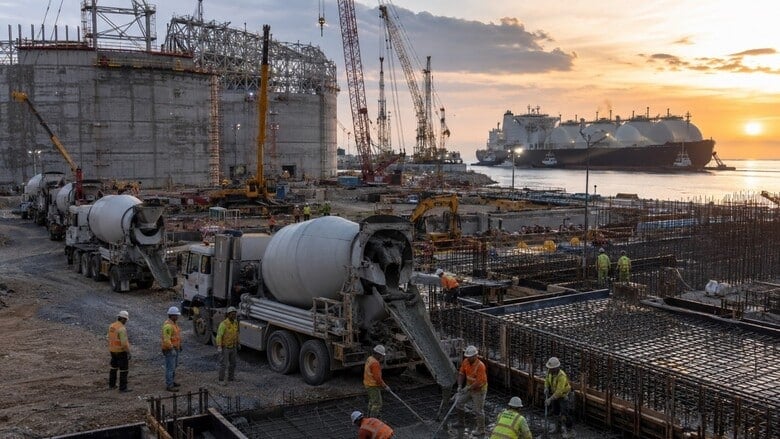
When a war winds down, you sell the war trade.
Crude just had its worst month in a year, and a deal to reopen the Strait of Hormuz is all but done. Every reflex you’ve got says lighten up on energy.
Cheniere went the other way.
On May 28, the same week oil fell apart, it handed Bechtel $4.69 billion to build more export capacity. Gas that won’t reach a single buyer until the back half of the decade.
Energy companies don’t write a $4.69 billion check on a guess about next quarter.
It’s what a company that lives and dies on this trade believes about the next ten years…
Signed into a falling market by people who read it better than anyone on the tape.
The “Poured Runway” Rule
There’s an old rule in businesses that build big, expensive things: you don’t pour a runway until you know the planes are coming.
A runway is concrete, permits, years, and money you can’t claw back. Nobody pours one on a maybe.
And you can’t pour one in a hurry. Permitting, engineering, and construction run for years. By the time the demand is obvious to everyone, it’s far too late to start laying asphalt.
-
So a freshly poured runway is worth more than any forecast. It means someone already knew and was willing to bet concrete on it.
The US LNG build is exactly that.
Sabine Pass, Corpus Christi, Plaquemines, and now Golden Pass, which shipped its first cargo in April as the ninth American export terminal, were all running below capacity while analysts still forecast a global gas glut.
The concrete set before anyone could point to the demand.
Then the planes landed, all inside four months…
Nord Stream stayed dead, and a missile hit Qatar’s Ras Laffan. A cyclone shut Australia’s export coast, Iranian crude came off the water, and Russian terminals dropped 40%.
Seven separate holes blown in global supply…
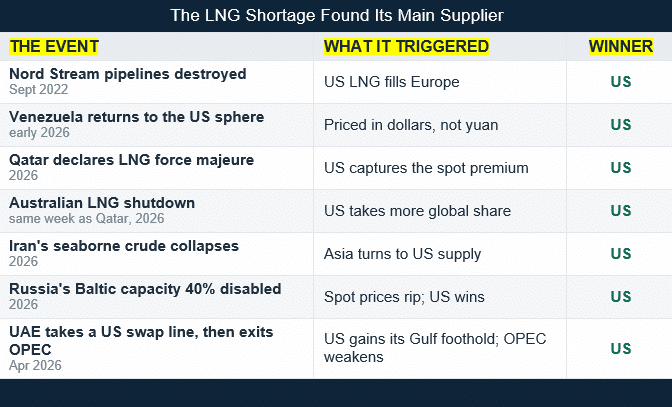
There was one place with spare gas already liquefying and ready to load: the US Gulf Coast. Nobody else had capacity sitting idle, waiting for the call.
So, the call came to America.
US exporters loaded a record 32.15 million tonnes in the first four months of 2026, up 28% on the same stretch last year. The extra 7 million tonnes came in just above the 6.93 million Qatar lost over the same period, almost exactly tonne for tonne.
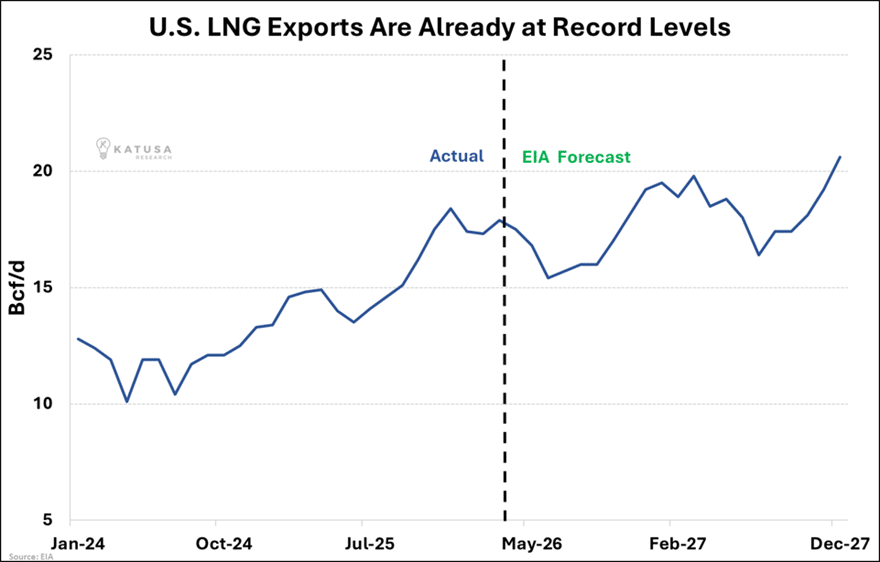
And the build doesn’t stop here.
- The capacity already under construction more than doubles America’s export reach again before the decade is out.
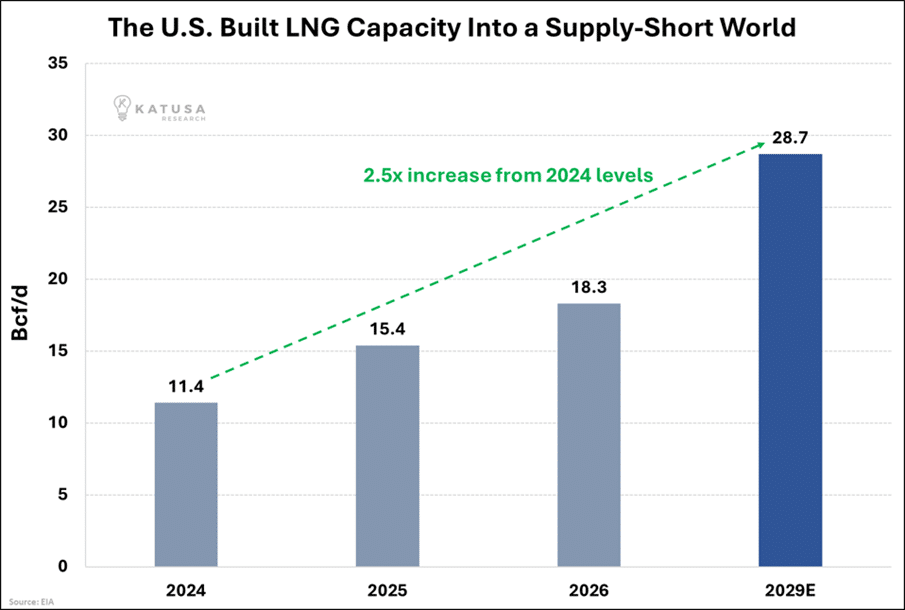
And into a world that is short of gas… and getting shorter.
Building Into a Falling Market
Shell made the same bet in April, paying $16.4 billion for a Canadian gas producer.
And a Philadelphia shipyard is building the first American-made LNG carrier since 1977, with delivery due in 2028.
-
You don’t break ground on a 2028 carrier because gas had a good March.
You do it because you’ve already read the next decade, and you want the asphalt down before anyone else sees it coming.
The crowd selling the de-escalation is trading the planes. The companies pouring concrete into a falling market are telling you the runway mattered more.
What Doesn’t Reverse
This is why this month’s gas price is the least interesting number on the page.
Henry Hub up 20% on a heat wave, TTF cooling as Hormuz reopens — that’s weather and headlines, and it cuts both ways.
Capacity doesn’t.
A terminal under construction doesn’t unpour because crude had a bad month.
The permits are signed, and the contracts run for twenty years with named buyers on the other end. None of it cares what the front-month did on a Friday.
You can still see who, because they’re the ones writing nine- and ten-figure checks into a market everyone else is leaving.
The macro case is built, and the policy is in place, with demand locked in for years.
-
Now the question every reader should be asking: who do you own to capture this trade?
The cleanest way to express this trade is through the producers… the companies that turn cheap American gas into global LNG at a massive spread.
The operator already pocketing the spread and the one the market is pricing for a failure it hasn’t earned, are broken down in Katusa’s Resource Opportunities, Cut to Kill.
Regards,
Marin Katusa
Get real-time alerts right away. Follow on X: @KatusaResearch and @MarinKatusa
Details and Disclosures
Investing can have large potential rewards, but it can also have large potential risks. You must be aware of the risks and be willing to accept them in order to invest in financial instruments, including stocks, options, and futures. Katusa Research makes every best effort in adhering to publishing exemptions and securities laws.
By reading this, you agree to all of the following: You understand this to be an expression of opinions and NOT professional advice. You are solely responsible for the use of any content and hold Katusa Research, and all partners, members, and affiliates harmless in any event or claim.
If you purchase anything through a link in this email, you should assume that we have an affiliate relationship with the company providing the product or service that you purchase, and that we will be paid in some way. We recommend that you do your own independent research before purchasing anything.
This is an expression of opinion and not professional advice. Neither Marin Katusa nor Katusa Research are registered broker-dealers or financial advisors. Past performance is not indicative of future results. When investing in speculative stocks, it is possible to lose your entire investment.
© 2026 Katusa Research / New Era Publishing Inc.