

|
1. The 4 most expensive words in your portfolio. You say them without thinking. They’re costing you. 2. The phantom portfolio your brain built without telling you. It’s valued at prices that no longer exist — driving every decision you make. 3. The biggest fund managers on earth are doing the same thing. And praying no one notices. |
What’s your number?
Don’t tell me you don’t have one.
Every investor has a price seared into their memory. A stock that hit a high.
Maybe you owned it, maybe you watched it run and kicked yourself for missing it. And that number is still sitting there, months or years later, shaping every decision you make around it.
You pull up the chart.
Your eyes go straight to the peak.
And without realizing it, you just made that peak the most important number in your analysis.
It’s not revenue, not cash flow. Not what the business actually earns. A number left behind from a moment that may never come again, like the stain on a basement wall after a flood recedes.
The moment is gone. The momentum that caused the high price has passed. The gurus aren’t as loud as they once were.
But the mark stays. And if you stare at it long enough, you start to believe the price belongs at that level that once was.
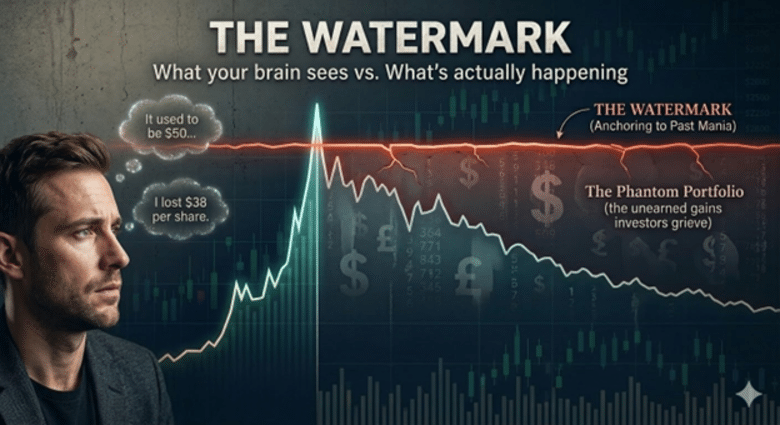
I call it the high watermark.
And it’s costing you more than you think.
“It Used to Be…”
These might be the four most expensive words in investing.
“It used to be $50… Now it’s $25.”
I hear some version of this almost every week. From retail investors, from friends at dinners, from people who have been in the markets for decades and still fall for it.
And every single time, the same questions get skipped.
Why was it $50? Was the whole sector caught in a mania? Was money cheap and flowing into anything with a ticker? Did a short squeeze jack the price up for three weeks before gravity took over?
The watermark investor doesn’t ask any of that.
They see $25 and their brain whispers half off. Like it’s a clearance rack and not a broken thesis.
In 2022, lithium spot hit $80,000 a tonne. That was the flood level. Small developers with marginal deposits ran to $5, $8, $12 a share from pennies. Today, lithium sits at around $19,000 per tonne.
If you’re still holding one of those small caps because “it used to be $8,” you’re ignoring that the $8 price required $80,000 lithium. At $19,000, that company’s foundation isn’t just lower… it’s likely underwater. Burning cash and waiting for a rescue.
And it’s not just you anchoring to that number.
The funds that bought near the top are trapped too. They’ll sell into every rally trying to get closer to their entry price, save their year, and protect their bonuses and jobs.
- That watermark is not a ghost in your head. A watermark is a ceiling. And there’s institutional money reinforcing it every time the stock tries to bounce.
And it goes deeper than public markets.
Private Equity ‘Mark to Phantom Past Market’
There are trillions of dollars in private equity sitting on asset valuations that are quietly anchored to the same kind of phantom pricing.
The manager knows the asset wouldn’t fetch the carrying value in a real sale today. But marking it down means killing the fund’s returns, their fees, and their next raise.
So, they hold the watermark and pray. It is the same reflex at institutional scale — and it’s a topic I’ll be covering in depth soon.
For a discount to be real, the value must remain the same.
If the conditions that pushed the price to $50 evaporated, that $50 was never a real price.
The Reflex You Don’t Notice You Have…
Think about the last stock you researched.
- Before you looked at a single financial metric, did you glance at the 52-week high?
Chances are you did. Almost everyone does. It takes half a second and it feels like nothing — just orienting yourself on the chart. But in that half second, your brain sets an anchor price. If the stock is near the high, it feels expensive.
If it’s far below, it feels bad. You made a valuation judgment before you read a single line of the financials. And that judgment wasn’t based on assets, margins, management, or the quality of the resource.
You didn’t analyze the company. You compared it to its own ghost.
The Phantom Portfolio and “Brutal Brain Calculation”
Now this next part does the most damage…
- When a stock in your portfolio drops from its peak, your brain does something brutal.
It calculates what your position would have been worth at the high. Not what you paid. Not what it’s worth now. What the position would have been worth at the top.
You build a ghost version of your portfolio — valued at the watermark — and you carry it around everywhere. You measure your real results against this phantom every single day.
And every single day, you feel like you’re falling behind. Even when you’re sitting on gains.
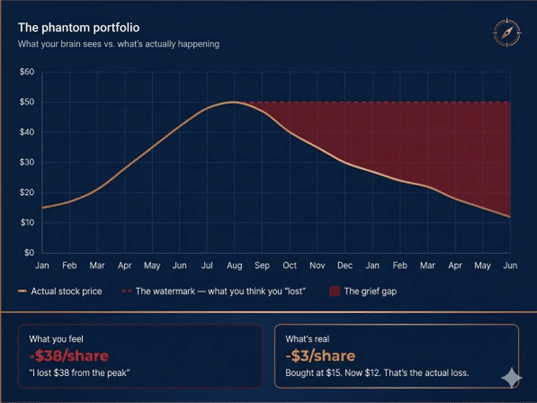
I’ve watched this play out across every commodity cycle I’ve traded through. A guy buys a stock at $15. It runs to $50.
He doesn’t sell. Fine, maybe the thesis still holds.
It pulls back to $30. He’s up 100% on his original investment. That’s an excellent result by any measure. But he doesn’t feel up 100%. He feels like he lost $20 a share.
The watermark hijacked his reference point.
$50 became his baseline, and now a winning trade feels like a losing one. Confidence shaken. Mindset changed. Ability to act frozen.
A real gain turns into a real loss. Not because the market took his money, but because a number on a chart convinced him he already had more.
You’re grieving money you never had.
Clean the Wall
Anchoring to peaks and 52-week highs is how our brains are wired. Losing something hits us about twice as hard as gaining the same thing.
This is deep programming, and simply knowing about it doesn’t override it.
What overrides it is discipline.
Next time you catch yourself measuring a stock against its watermark, force yourself through two questions.
- First: what specific conditions created that peak? Sector mania, cheap money, a squeeze, a speculative cycle — or real fundamental growth?
- Second: do those conditions still exist today?
If they do, the watermark might be telling you something useful. A strong business trading below its peak because of temporary market noise is exactly where the best opportunities hide.
But if those conditions are gone — if the storm has passed — the watermark is a ghost. And you need to value what’s in front of you, not what’s behind you.
Three things to take with you:
- The watermark is a record of conditions, not a record of value. A stock’s peak tells you what the market believed at one specific moment. It says nothing about what the company is worth today.
- The phantom portfolio is the most expensive portfolio you’ll ever own. Every dollar you “lost” from a peak is a dollar you never actually had. Stop measuring real positions against imaginary ones.
- If you can’t name the conditions that created the peak, you never understood the trade. Before you anchor to any high, you need to explain exactly why it got there — and whether those reasons still hold.
Stop staring at the stain and look at the foundation underneath.
That’s where the answer is.
Regards,
Marin Katusa
Get real-time alerts right away. Follow on X: @KatusaResearch and @MarinKatusa
Details and Disclosures
Investing can have large potential rewards, but it can also have large potential risks. You must be aware of the risks and be willing to accept them in order to invest in financial instruments, including stocks, options, and futures. Katusa Research makes every best effort in adhering to publishing exemptions and securities laws.
By reading this, you agree to all of the following: You understand this to be an expression of opinions and NOT professional advice. You are solely responsible for the use of any content and hold Katusa Research, and all partners, members, and affiliates harmless in any event or claim.
If you purchase anything through a link in this email, you should assume that we have an affiliate relationship with the company providing the product or service that you purchase, and that we will be paid in some way. We recommend that you do your own independent research before purchasing anything.