Oil’s Phantom Barrels
You’re reading oil data wrong.
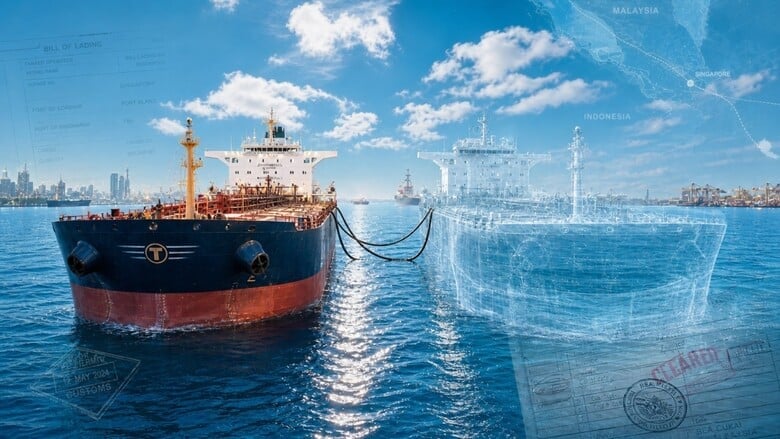
When you read that China imports 11% of its oil from Malaysia, you picture tankers leaving Malaysian ports.
You should check the math.
Malaysia produces 355,000 barrels a day and consumes nearly a million. The country uses three barrels for every one it pumps out of the ground.
Indonesia is worse: 605,000 barrels of production a day against 1.7 million in consumption. It has to fill that 1.1 million barrel gap somehow.
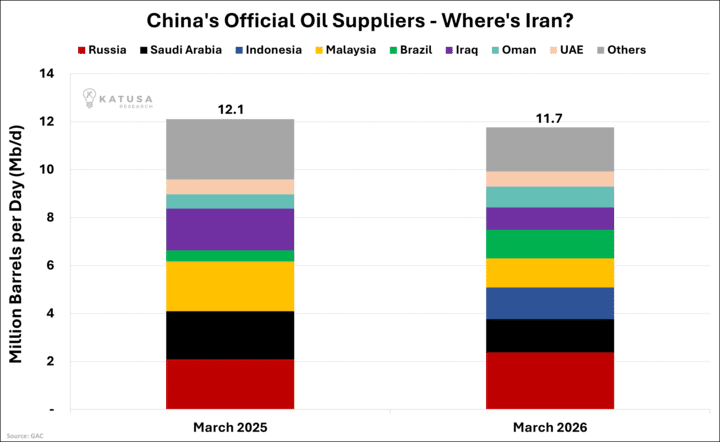
Yet Chinese customs data says Indonesia and Malaysia together supply 21% of China’s crude imports.
Two net importers, larger combined than Saudi Arabia on China’s official ledger.
The math doesn’t square.
The gap between the arithmetic and the official numbers is the most important trade setting up in global energy right now.
Phantom Barrels
The barrels are real, but there’s a little problem…
The exporter on the customs slip isn’t.
Iranian crude moves to a transshipment point off the Malaysian coast: Linggi, Tanjung Pelepas, the southern straits.
There, the cargo is transferred ship to ship, blended with crude of legitimate origin, given new paperwork, and sailed to a Chinese port flying a Malaysian or Indonesian flag.
Russian crude takes a similar route through Singaporean and Indonesian waters and has done so since 2022. The Iranian version of the route is older, built up after the 2018 sanctions reimposition, and has carried the bulk of Iran’s oil revenue for the better part of a decade.
The cargo gets logged as transit in Singapore, blended in Indonesian waters, and recorded as Indonesian or Malaysian on the Chinese customs slip.
This isn’t unheard of.
- Venezuela ran a version of this play during the 2019–2024 sanction years, called “Ghost Ships”.
Their cargoes were reflagged through Cuba and Russia. And it was growing until the US military stepped in.
AIS spoofing, where a ship broadcasts a fake location, is up over 200% since 2022.
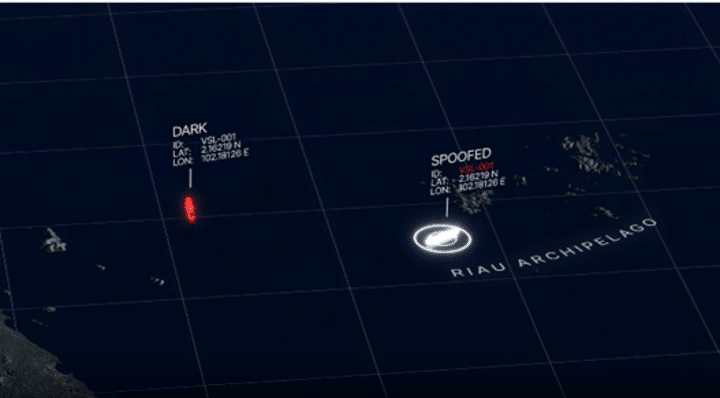
Screenshot from PlanetLabs website “Dark Fleet”
If you’re keeping track, that’s three sets of paperwork for one set of barrels.
Analysts call them phantom barrels. They carry real crude on fake paperwork.
This is the trade that lets Iran sell roughly 1.4 million barrels a day under sanctions that, on paper, are total.
Kpler tracks the flows in real time, and S&P Platts has published case studies on the route.
The wires report the official numbers because the official numbers are what governments release.
It’s just that the math doesn’t add up, and every analyst who matters knows this.
What changed in the first quarter of 2026 is that the phantom route cracked.
Cracks in “Old Oil”
Three pressures collapsed onto the phantom-barrel trade in the same quarter.
On February 28, the United States and Israel went to war with Iran.
The Strait of Hormuz (which carries roughly a fifth of the world’s seaborne oil), became contested.
Insurance markets pulled war-risk coverage on March 2 with 72 hours’ notice, and transits dropped 81%.
Russia’s seaborne export capacity was knocked offline by 40% over the same period. The cause was sustained drone strikes on terminals, refineries, and the shadow fleet itself, all of it on the public record.
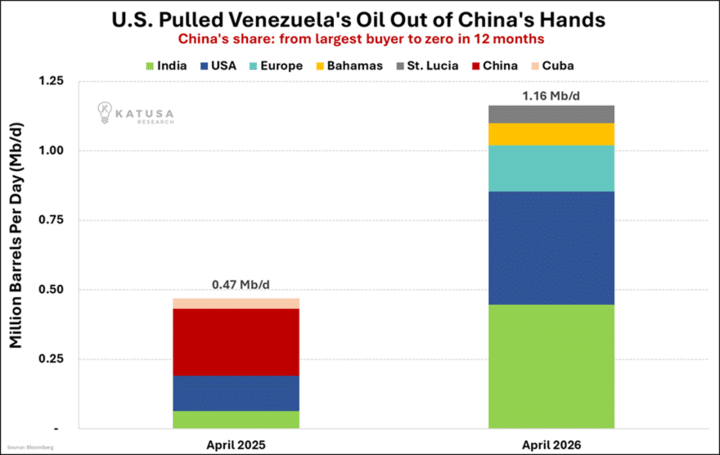
- Venezuelan crude, which was just under 5% of China’s imports and three-quarters of Venezuela’s total exports, ran to zero in April 2026.
The barrels that used to settle in yuan now settle in dollars and ship to refineries in the US sphere.
Add Iran’s roughly 11% (laundered through Indonesia and Malaysia), Russia’s net loss to China of around 6.6% of imports, and Venezuela’s ~5%.
By April, more than a fifth of China’s crude had walked off the customs ledger.
The Rise of America
Beijing has a strategic reserve and public estimates put it above 1 billion barrels.
- At ordinary consumption rates, that buys China months of cushion against the shortfall, not years.
After that, China sits down with Washington.
Higher oil prices for China, a weaker yuan, and a settlement currency that says United States on the front of every note.
The phantom barrels were China’s way of buying crude on China’s own terms — sanctioned product, settled outside the dollar system, at a discount nobody had to declare. That arrangement is closing.
What replaces it is a deal at market prices, in dollars, on America’s terms.
The deal is forced by inventory clocks, not by political resolve. China can buy at the new price in dollars, or it can run its refiners short. Every month that passes without a deal is a month closer to a refining slowdown that no Five-Year Plan can wave away.
The wires will tell you the official numbers, but the official numbers don’t reconcile.
That’s the trade.
- The 4 names that capture this trade are in the May issue of Katusa’s Resource Opportunities — Cut to Kill.
Regards,
Marin Katusa
Get real-time alerts right away. Follow on X: @KatusaResearch and @MarinKatusa
Details and Disclosures
Investing can have large potential rewards, but it can also have large potential risks. You must be aware of the risks and be willing to accept them in order to invest in financial instruments, including stocks, options, and futures. Katusa Research makes every best effort in adhering to publishing exemptions and securities laws.
By reading this, you agree to all of the following: You understand this to be an expression of opinions and NOT professional advice. You are solely responsible for the use of any content and hold Katusa Research, and all partners, members, and affiliates harmless in any event or claim.
If you purchase anything through a link in this email, you should assume that we have an affiliate relationship with the company providing the product or service that you purchase, and that we will be paid in some way. We recommend that you do your own independent research before purchasing anything.
This is an expression of opinion and not professional advice. Neither Marin Katusa nor Katusa Research are registered broker-dealers or financial advisors. Past performance is not indicative of future results. When investing in speculative stocks, it is possible to lose your entire investment.
© 2026 Katusa Research / New Era Publishing Inc.