

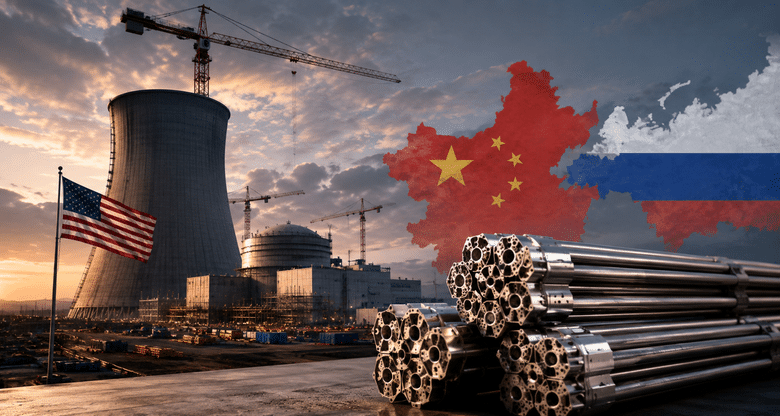
- The countries that can fill the 70% fuel gap are a problem.
- You checked everything before you bought…. except what the reactor eats.
- BEST CASE, America makes 30% of its own reactor fuel by 2030.
If you bought a nuclear stock in the past two years, you probably did what almost everyone did.
You checked the reactor design, the government backing, and which tech giant was writing the cheques, and then you watched the whole sector double.
You never asked what the reactor eats.
That blind spot in your homework is now the most important variable in the entire nuclear trade, and it decides who wins the correction.
What the Reactor Eats
Today’s fleet runs on uranium enriched to about 5%. The next generation of small modular reactors runs on HALEU, uranium enriched between 5% and 20%.
This is because the higher enrichment gives a smaller reactor longer fuel cycles and more output per square foot. It also means the new fleet needs a fuel America barely produces.
A single demonstration cascade of sixteen centrifuges in Ohio is the only licensed HALEU source in the country. It started enriching in October 2023, and by mid-2025 its total lifetime output was 920 kilograms.
Twenty months of production, and the whole pile weighs less than a compact car.
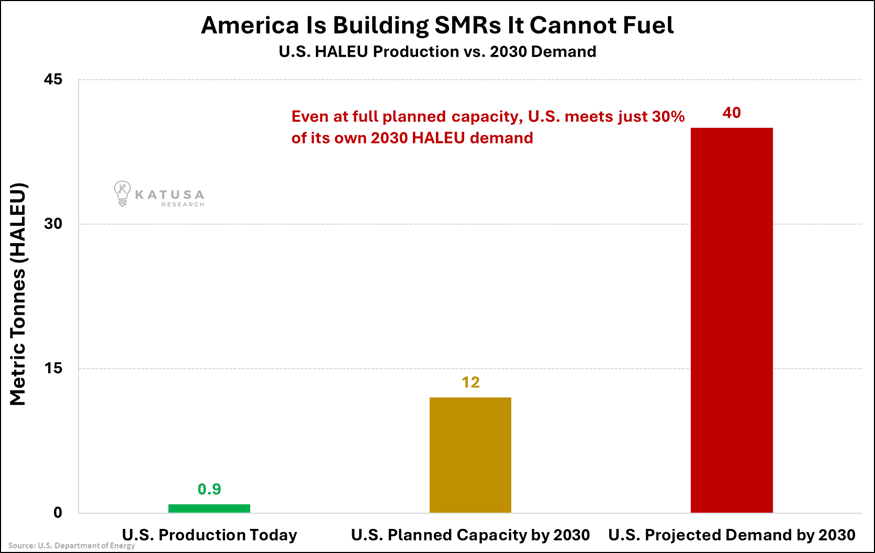
Run the numbers forward, and the gap widens.
US HALEU production today is 0.9 metric tonnes per year. If every planned facility gets built on schedule and hits every one of its targets, domestic capacity reaches about 12 tonnes by 2030. The Department of Energy projects demand above 40 tonnes by then.
- Best case, America produces 30% of the fuel its own reactor buildout requires.
The only two countries producing HALEU at scale today are Russia and China. America banned Russian imports in May 2024.
There is a partial bridge, though.
In September 2025, regulators cleared the country’s one commercial enrichment plant, in New Mexico, to push enrichment up to 10%, which helps some designs. But the reactors the hyperscalers are funding need full HALEU, and 10% material is a feedstock for making HALEU, not a substitute for it.
Four of Every Ten Pounds
The problem runs deeper than the new fuel…
- America’s existing fleet already runs on uranium it doesn’t mine.
In 2024, US utilities bought 55.9 million pounds of uranium, and 92% of it was foreign-origin. American mines produced just 677,000 pounds all year. Call it 1% of what the fleet consumed.
Canada and Australia cover about half of the imports. Reliable friends (for the most part, if you ignore Canadian elbows).
But Kazakhstan supplied 24% of deliveries, Uzbekistan 9%, and Namibia and Russia 4% each, which means four of every ten pounds feeding American reactors come from -SWAP Line Nations, countries the Fed would never backstop in a crisis.
Washington saw this before the market did.
Through late 2024 and 2025 came DOE enrichment contracts, DoD equity stakes in fuel cycle companies, and the ADVANCE Act to speed up licensing. That was billions of dollars committed to rebuilding, from scratch, a supply chain America had let rot for thirty years.
Then the Market Bought Everything
The re-rating that followed was one of the most violent I’ve seen in resource investing, and we built two indexes to track it.
- One holds the advanced reactor developers.
- The other holds the nuclear infrastructure and fuel companies that feed them.
The developer index ran as high as 337% by October 2025. The infrastructure index reached 245% over the same stretch.
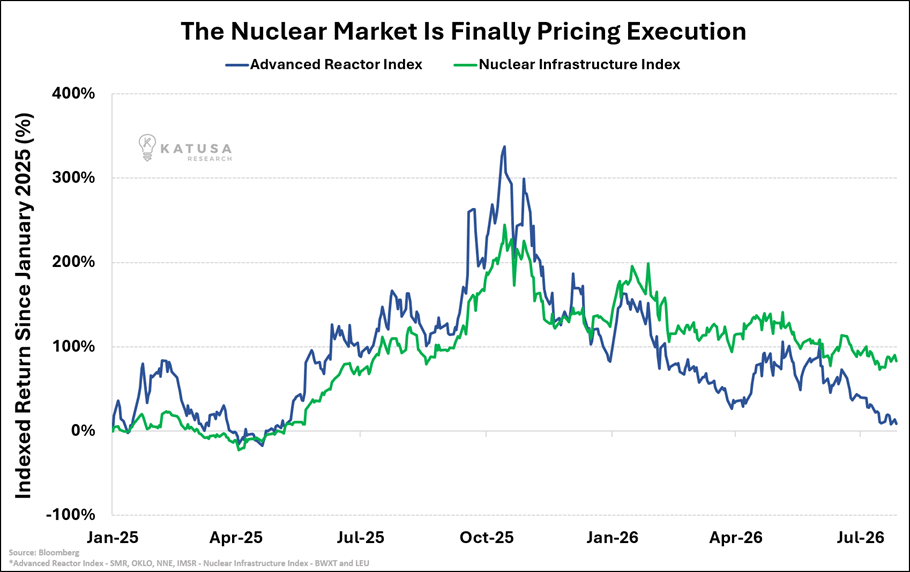
Then gravity. The developer index fell 56% from its peak, and the infrastructure index gave back 37%.
The thesis didn’t break. I am a long term uranium and nuclear bull. And we haven’t seen anything yet in the energy bull market.
The demand, the government money, and the fuel gap are all real.
What broke was the idea that you could buy this sector fuel-blind: owning reactors on paper without ever asking which companies have fuel access, signed contracts, regulatory milestones, and funded balance sheets. And which ones have a story and a rendering.
- For the next several years, fuel is the chokepoint every nuclear business plan must pass through.
Companies on the right side of it will sign contracts on their own terms, while companies on the wrong side burn cash waiting for allocations that may never come. That sorting is what the correction started, and it is not finished.
We first published on SMRs to Katusa’s Resource Opportunities members in May 2024, in an issue called Powering The Electron Rush. Before the massive run-up and the correction.
We just finished that sorting for Katusa’s Resource Opportunities members. We put the whole field through the fuel test: fuel access, regulatory progress, construction timelines, and a balance sheet that can survive the wait.
- Fifteen companies made the cut.
- The spread inside those fifteen is brutal.
One fuel company trades at a 32% discount (and counting) to contracts it has already signed. The market is paying you to wait.
One reactor developer collected two NRC approvals in eight months and still trades at seven cents per planned megawatt, while its closest peers trade at seventy cents to nearly a dollar.
Another survivor has 419 months of runway at its current burn rate, and one of the most famous names in the sector has 49.
And the two strongest reactor programs in the country can’t be bought on any exchange at all, which changes what every public name is actually worth.
The names are in my premium research service – Katusa’s Resource Opportunities.
Regards,
Marin Katusa
Get real-time alerts right away. Follow on X: @KatusaResearch and @MarinKatusa
Details and Disclosures
Investing can have large potential rewards, but it can also have large potential risks. You must be aware of the risks and be willing to accept them in order to invest in financial instruments, including stocks, options, and futures. Katusa Research makes every best effort in adhering to publishing exemptions and securities laws.
By reading this, you agree to all of the following: You understand this to be an expression of opinions and NOT professional advice. You are solely responsible for the use of any content and hold Katusa Research, and all partners, members, and affiliates harmless in any event or claim.
If you purchase anything through a link in this email, you should assume that we have an affiliate relationship with the company providing the product or service that you purchase, and that we will be paid in some way. We recommend that you do your own independent research before purchasing anything.