Energy Bottleneck: The Electron Ceiling
You can design a better chip, you can’t design a gigawatt.
You never once worried about whether the lights would turn on.
Power arrives when you flip the switch.
That reflex, that power is infinite and instant and basically free, is one of the most reasonable assumptions you’ve ever made.
It was true your entire life.
The companies racing to build artificial intelligence just found out it’s false.
For most of the last twenty years, the biggest buyers of industrial-scale infrastructure were governments.
That era is over.
Five American tech giants will spend $595 billion building AI infrastructure this year alone.
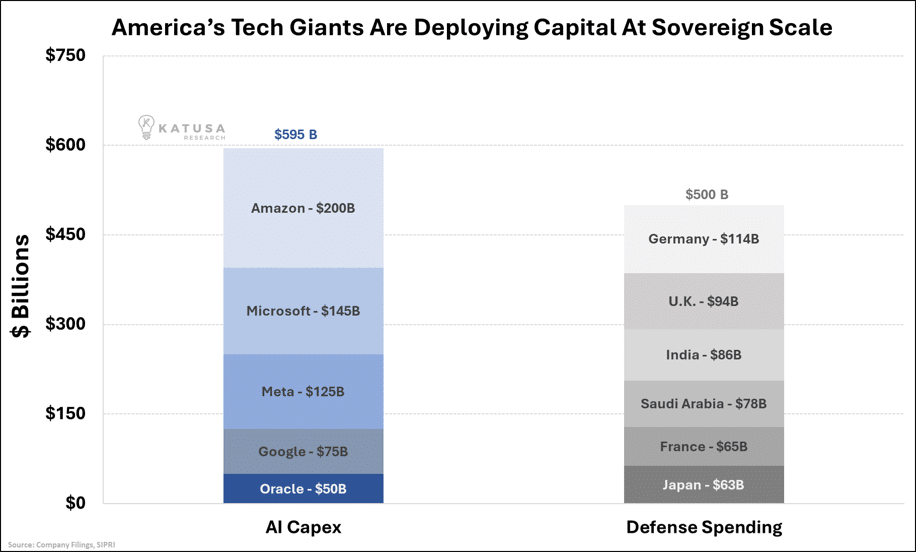
- That number is bigger than the combined defense budgets of Germany, the UK, India, Saudi Arabia, France, and Japan.
That’s six of the ten biggest militaries on earth, at $500 billion between them.
Every dollar of it runs on the thing you never think about…
Microsoft, Google, Amazon, and Meta have all said the same thing out loud: power availability is now the limit on how fast they can build.
They have chips on order, and plenty of cash is in the bank.
The one thing these companies can’t conjure is electricity, so they sit in line and wait for the grid to give them some.
For more than a decade, US electricity demand went nowhere. It sat flat below 3.75 trillion kilowatt-hours while utilities planned their entire strategy around a line that refused to move.
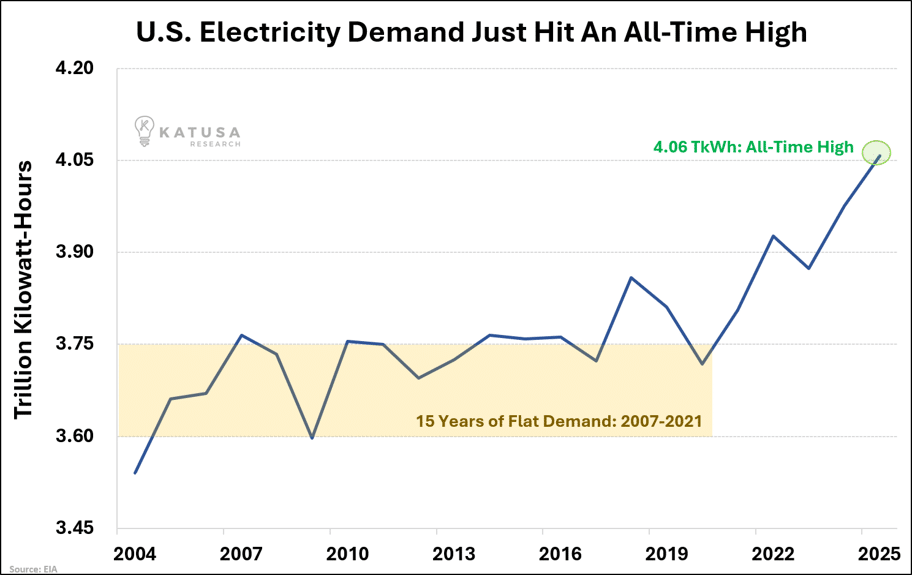
Then AI arrived, and the line went vertical.
Demand hit an all-time high of 4.06 trillion kilowatt-hours, a jump of roughly 9% in five years after more than a decade of standing still.
That’s the Electron Ceiling.
And power is not like the rest of the stack.
A chip gets faster and cheaper every eighteen months; that’s the entire history of computing.
A power plant does not. It obeys physics and permits, and both of those move on a timeline measured in years.
You Can Design a Better Chip. You Can’t Design a Gigawatt.
A large data center draws 500 to 1,000 megawatts.
That’s about what a full-size power plant produces running flat out, all day, every day.
And a training cluster never sleeps. Every minute it’s offline is a minute of idle hardware that cost billions to install.
So the requirement is brutal and specific. Enormous amounts of reliable power, every hour, for decades, at a price you can plan around.
Run that filter, and the field collapses fast.
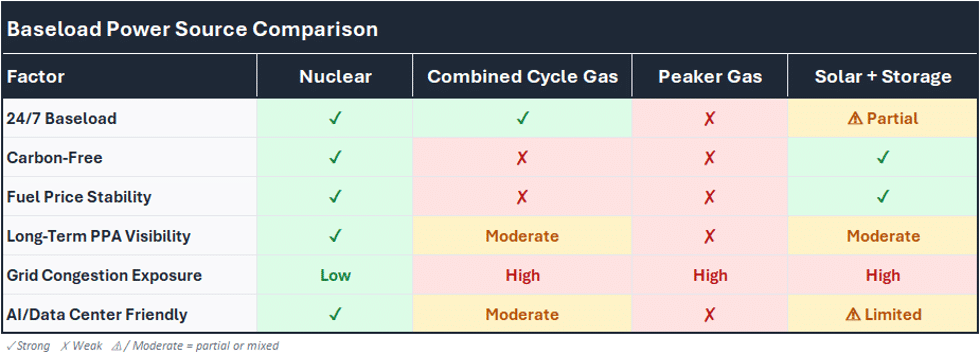 Source: Katusa Research. Natural gas shown as combined-cycle baseload.
Solar and wind do real work on the broader grid, but at hyperscale they need storage, transmission, and backup to deliver the reliability these sites demand.
Natural gas solves the always-on problem, then hands you fuel-price exposure no twenty-year budget can absorb.
Nuclear runs around the clock, on stable fuel costs, from a single site, for decades.
- For a machine that runs continuously, the power feeding it must run continuously too.
Over the last two years, the biggest technology companies on earth quietly signed more than 12,000 megawatts of nuclear power into binding contracts.
Some as purchase agreements with existing operators, some as direct funding of the developers building the next generation of reactors.
Every major hyperscaler, all at once, all reaching for the same boring asset. Line the deals up side by side, and the pattern is hard to miss.
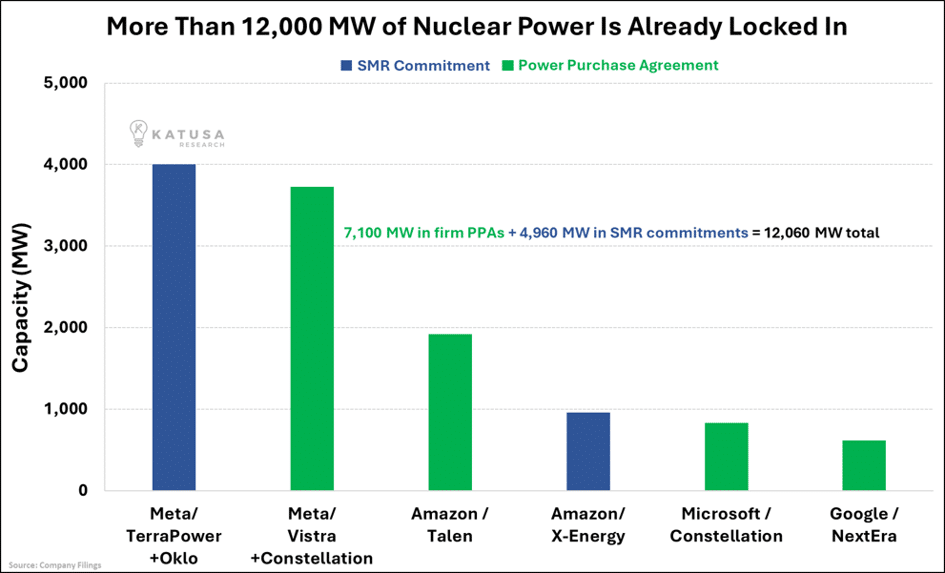
- Four of the most sophisticated buyers in the world made the same move at the same time, before most of the market noticed power was the problem.
Companies like that don’t coordinate, and they don’t commit this much capital on a hunch. When they quietly land on the same answer at once, the question worth asking is what they saw before everyone else did.
It changes the whole AI question, too.
You’ve been told the race goes to the best model.
It may go to whoever locks up the power first, and that’s a very different list of companies to own.
The Energy Bottleneck Shifted… Again
But the next generation of reactors needs a specialized fuel that America barely produces.
And the supply chain for it still runs through the one country this entire buildout was built to escape.
America is now building reactors it cannot yet fuel.
A few things to carry out of this:
- Power is the AI bottleneck, not chips. The companies building AI have said so themselves. The constraint moved to the one input that can’t be accelerated by software.
- The biggest buyers already moved. More than 12,000 megawatts of nuclear is under contract across every hyperscaler at once, while most of the market is still watching Nvidia.
- Own what every model needs. You don’t have to guess which model wins. You can own the power, the fuel, and the infrastructure every one of them needs.
One more thing…
That was the industrial side: the machines, the power, the metal.
There’s a monetary side stacking on top, and it’s repricing gold right now.
The same players spending hundreds of billions to build through this wall are printing the dollars to do it, and money that never touched gold is pouring in.
Here’s why I bring it up…
- Two weeks ago I handed KRO members a small gold company and one instruction: buy under $2. It’s around $3.45 today.
That’s better than 71% in under two weeks, while the gold price itself fell.
My members saw it first.
And that’s the whole point of getting in early… and next week, you can.
It’s our 10th anniversary at Katusa Research…
And I’m reopening the 2016 founding price my first members paid, untouched for a decade.
Everything lands in your inbox in a few days. Don’t miss it.
Regards,
Marin
Get real-time alerts right away. Follow on X: @KatusaResearch and @MarinKatusa
Details and Disclosures
Investing can have large potential rewards, but it can also have large potential risks. You must be aware of the risks and be willing to accept them in order to invest in financial instruments, including stocks, options, and futures. Katusa Research makes every best effort in adhering to publishing exemptions and securities laws.
By reading this, you agree to all of the following: You understand this to be an expression of opinions and NOT professional advice. You are solely responsible for the use of any content and hold Katusa Research, and all partners, members, and affiliates harmless in any event or claim.
If you purchase anything through a link in this email, you should assume that we have an affiliate relationship with the company providing the product or service that you purchase, and that we will be paid in some way. We recommend that you do your own independent research before purchasing anything.
This is an expression of opinion and not professional advice. Neither Marin Katusa nor Katusa Research are registered broker-dealers or financial advisors. Past performance is not indicative of future results. When investing in speculative stocks, it is possible to lose your entire investment.
© 2026 Katusa Research / New Era Publishing Inc.