
Bessent’s Notepad
Washington rescued the yen. Can it rescue what’s next?

Last Friday, a Reuters photographer zoomed in on a notepad.
Treasury Secretary Scott Bessent carried it into a Camp David cabinet meeting with one handwritten line facing the camera: “Buy Japanese Yen (JPY) $5-10 bill.”
Within days, Japan’s finance minister confirmed the two governments are stepping into the market together, the first joint yen purchase since June 1998.
If you hold a mortgage or a bond fund, that notepad was written for you. The chain behind it starts five months earlier, in the Strait of Hormuz.
Hormuz Sends Japan the Bill
Japan imports over 99 percent of its crude oil.
Around 95 percent comes from the Middle East, and roughly 70 percent sails through the Strait of Hormuz.
When the United States entered the war with Iran on February 28, every barrel got dearer, and every tanker got riskier.
The damage piled up fast:
- Japan’s total import bill reached a record 11.3 trillion yen in June, up 25.4 percent from a year earlier
- The June trade deficit hit 407 billion yen against forecasts of 120 billion
- The IEA approved its largest oil release ever, 400 million barrels, with Japan draining almost 80 million from its own reserves
Yen Buckles
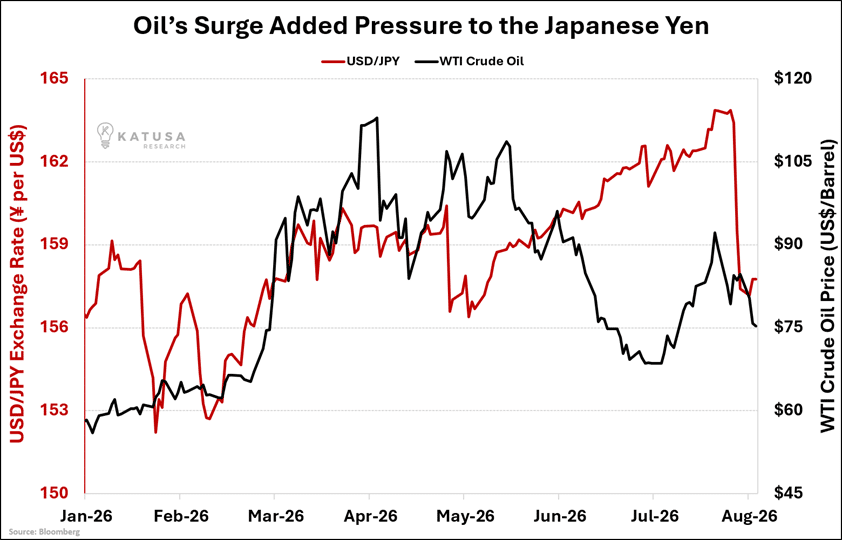
The yen, already weak, slipped past ¥158/US$ in March.
And Japan’s Finance Ministry asked traders about buying crude futures to contain the damage. When a finance ministry weighs oil trades to defend its currency, the two markets have fused.
Tokyo fought alone at first and Reuters estimated its July 30 operation may have reached $59 billion.
The yen still slid to nearly ¥164/US$ in late July, its weakest since 1986.
Why Couldn’t Tokyo Out-Hike the Pressure?
For almost thirty years, Japanese money was close to free.
And the world borrowed cheap yen to buy assets that paid more.
The Bank of Japan has been raising rates, and its 1 percent today is a thirty-year high.
A small hike in the summer of 2024 was enough to break things: the unwind of those yen loans sent the Nikkei down 12.4 percent on August 5, its worst day since 1987, erasing roughly $790 billion.
The traders who borrowed yen for free have lost fortunes. Yet dollars still pay far more. The Fed holds its rate at 3.50 to 3.75 percent, and the US 10-year pays close to 4.7 percent.
That left Tokyo boxed in. Hike faster and risk breaking markets again, or hold still and watch the oil bill sink the yen.
The box is why the notepad came out.
America Buys Yen Without Dollars
The New York Fed bought yen through Goldman Sachs and Morgan Stanley, funding the trade by selling euros.
The operation never touched America’s own currency.
Before last week, Washington intervened in currency markets just three times since the mid-1990s: 1998, 2000, and 2011.
When Washington starts buying someone else’s currency, the stress has climbed above the market’s pay grade.
The yen snapped back toward ¥157/US$ within days.
What Was America Protecting?
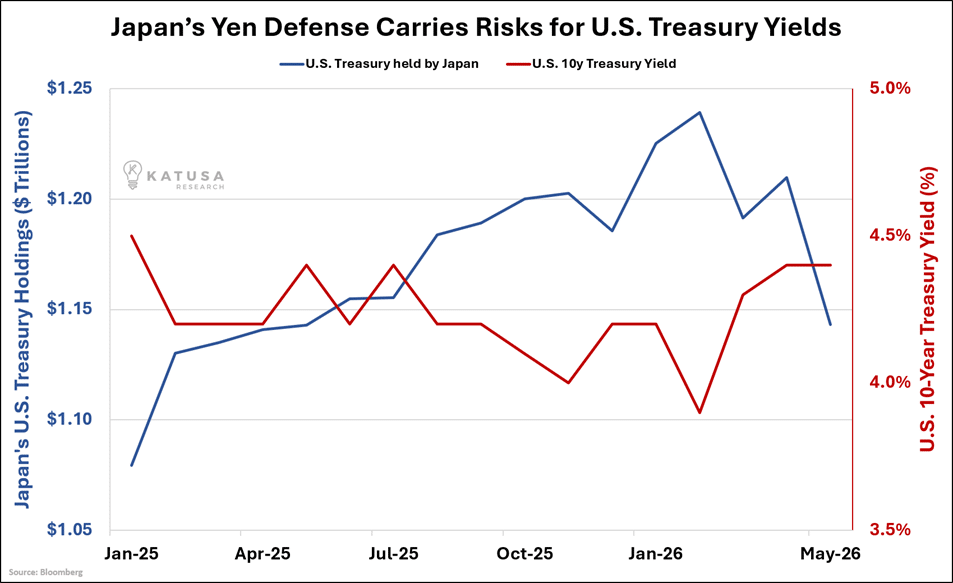
Japan holds about $1.14 trillion of US Treasuries, more than any other country on earth.
Repeated yen defense can force Tokyo to sell those dollar assets bonds, and heavy selling pushes US yields and American mortgage rates higher, with your mortgage rate riding on top.
In May alone, Japan’s holdings fell $66.8 billion (to $1.143T).
The operation used euros, so it placed no direct selling pressure on the dollar.
And the protection runs through the bond market: America joining the fight cuts the number of Treasuries Japan must sell.
Bessent framed the intervention as support for a trusted ally. Viewed another way, the yen rescue also protects the Treasury market.
I call this the Dependence Chain.
Japan imports 99 percent of its oil, so a Gulf war sank the yen. America borrows over a trillion dollars from Tokyo, so a sinking yen threatened US yields.
The next link sits in metal.
Copper Has No Rescue
America imported 57 percent of the refined copper it used in 2025.
The market it buys from is already distorted by tariffs and increasingly tight outside the United States.
Washington taxes semi-finished copper products at 50 percent, and a decision on extending tariffs to refined copper itself now sits on the President’s desk.
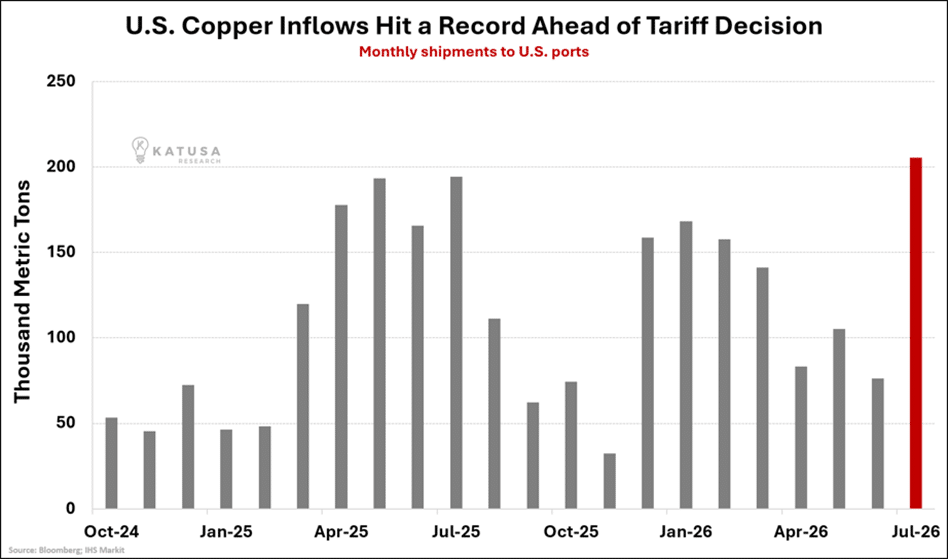
The market is front-running that decision at record scale.
More than 200,000 tonnes arrived at US ports in July.
That’s the biggest monthly inflow in shipping records going back to 2014.
- And New York’s premium over London has stretched to nearly $600 a tonne.
Supply keeps tightening underneath the stampede.
Smelter outages left 16 percent of global refining capacity idle last quarter. Chile’s idle capacity sits at its highest since 2019, and Shanghai’s deliverable stocks have collapsed 82 percent since May.
COMEX copper trades at $6.64 a pound, near its all-time high, and London copper sits around $14,000 a tonne. That’s before the tariff decision or the drawdown has finished working.
The full copper story is bigger than one letter can hold.
A weak yen can be bought, and Treasuries can be borrowed against.
No notepad can conjure a refined tonne of copper. The smelters were never built.
Idle smelters, global inventory cover you can count in days, and a supply gap that widens past 2029 all sit under this price.
I discuss that story in this month’s Katusa’s Resource Opportunities…
And put close to 20 copper stocks through the KR Screener.
One stands above all.
Click here to become a member and find out.
Regards,
Marin Katusa
Get real-time alerts right away. Follow on X: @KatusaResearch and @MarinKatusa
Details and Disclosures
Investing can have large potential rewards, but it can also have large potential risks. You must be aware of the risks and be willing to accept them in order to invest in financial instruments, including stocks, options, and futures. Katusa Research makes every best effort in adhering to publishing exemptions and securities laws.
By reading this, you agree to all of the following: You understand this to be an expression of opinions and NOT professional advice. You are solely responsible for the use of any content and hold Katusa Research, and all partners, members, and affiliates harmless in any event or claim.
If you purchase anything through a link in this email, you should assume that we have an affiliate relationship with the company providing the product or service that you purchase, and that we will be paid in some way. We recommend that you do your own independent research before purchasing anything.
This is an expression of opinion and not professional advice. Neither Marin Katusa nor Katusa Research are registered broker-dealers or financial advisors. Past performance is not indicative of future results. When investing in speculative stocks, it is possible to lose your entire investment.
© 2026 Katusa Research / New Era Publishing Inc.