
America’s Most Valuable Acre is Empty
America keeps its emergency oil in a hole.
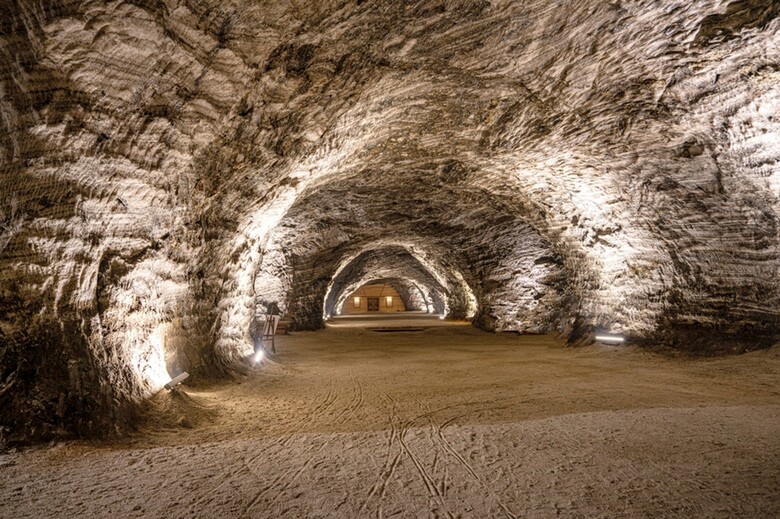
On January 10, 1901, six tons of drilling pipe blew right up into the air from a well outside Beaumont, Texas.
Then came mud. Then gas.
Then oil.
The Lucas gusher ran at a hundred thousand barrels a day for nine days.
It started the Texas oil age, and under it was a rock you’ve salted your eggs with all your life and never once thought of owning.
A salt dome.
For a century, oilmen asked what the salt trapped.
The people writing cheques now ask what it can hold, because the valuable part of this rock is the part you take out.
You’d never guess who holds the biggest ones.
The good folks at the DOE are who keep every barrel of the country’s emergency oil.
Where A Salt Dome Comes From
A salt dome starts as a dead sea.
In the age of the dinosaurs, an ocean over the Gulf Coast dried out and left a salt bed thousands of feet thick, and rivers buried it under miles of mud.
Under that weight, salt does something no other rock does: it flows, slowly, like the ice at the base of a glacier. Over millions of years, it pushed up through the heavier rock above it like a giant plug squeezing toward the surface.
In November 1980, a crew drilling on a Louisiana lake nicked the roof of the salt mine inside the dome below. The lake went down the hole in hours and took eleven barges and sixty-five acres of an island with it.
Nobody died.
What swallowed the lake was plain fresh water eating through salt, and that same trick is how you make a vault.
Salt Was About as Boring as a Commodity Gets…
Americans dump millions of tons of it onto roads every winter.
In 2025, the average value of U.S. rock salt was just $54 per metric ton. Cheap enough to spread on a highway and watch it disappear down a storm drain.
Then comes the clever part: Drill into a dome, pump fresh water down, and dissolve the salt.
- SIDE NOTE for the technocrats among my readers, you can also use brine, but it just takes a bit longer to dissolve out the cavern.
Next, pump the brine back out and what remains isn’t a mine…
It’s a gigantic underground bottle.
Meet America’s 714-Million-Barrel Underground Vault
The United States doesn’t store its emergency oil in giant steel tanks.
It stores most of it inside salt.
Along the Gulf Coast, the Strategic Petroleum Reserve contains 60 enormous underground salt caverns spread across four sites in Texas and Louisiana.
Together, they are authorized to hold 714 million barrels of crude oil.
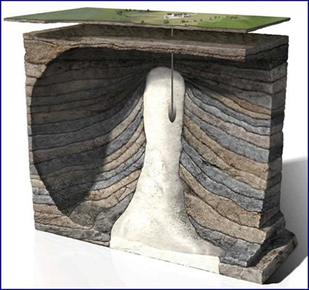
Image: Illustration of the Brand Mound DOE Storage Site (source)
The typical cavern is roughly 200 feet across and 2,500 feet tall and holds around 10 million barrels.
That is tall enough to swallow Chicago’s Willis Tower with room left over.
And salt happens to be unusually good bottle material.
At these depths, rock salt has extremely low porosity and permeability. It also deforms slowly under pressure.
Most interesting of all, small cracks squeeze themselves shut. Salt heals its own cracks, like a superhero.
That combination is why the Department of Energy says salt-cavern storage can cost up to 10 times less than above-ground tanks and 20 times less than caverns mined from hard rock.
The U.S. government took one of the cheapest commodities on earth…
Removed it…
And turned the empty space into infrastructure capable of holding hundreds of millions of barrels of the world’s most important commodity.
Dear Canada, please take note of how it’s done…
The US DOE did this great and better than anyone else on the planet.
The Hole Outlasts the Oil
The reserve fell below 300 million barrels in August, its lowest since the caverns were filled in the early 1980s, and sits around 285 million today.
The argument in Washington moved from how much oil was left to whether the holes would survive.
A government audit warned in May that every refill cycle dissolves more walls, and the Energy Department says 70 million barrels can never come out.
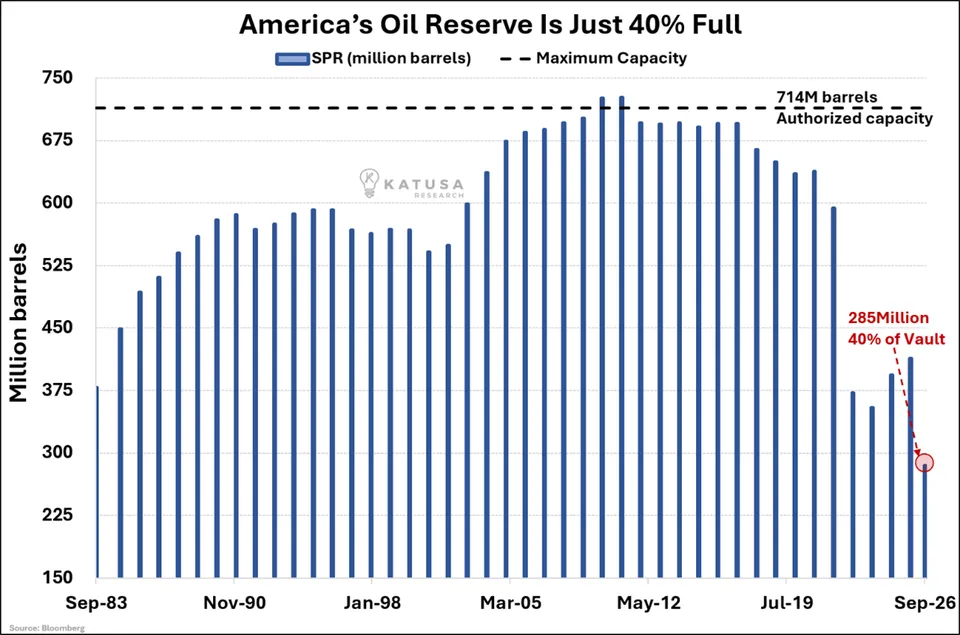
Picture the oil as the tenant and the hole as the building.
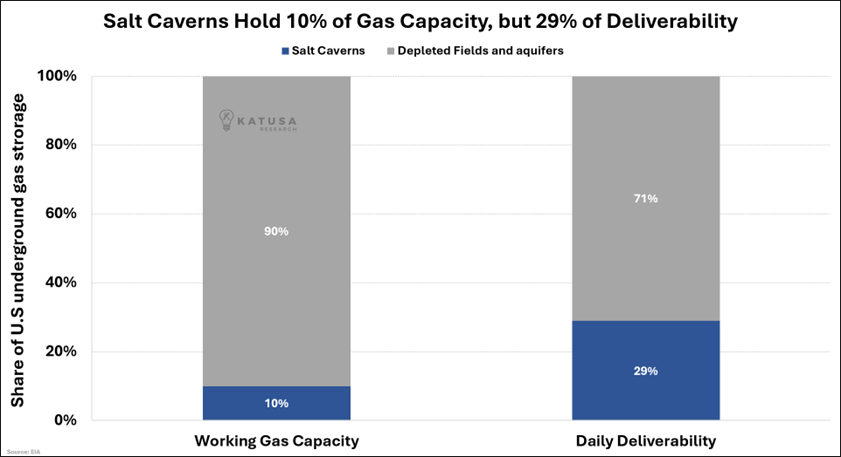
Salt caverns hold about a tenth of the country's gas storage but more than a quarter of its daily withdrawal capacity.
Because a bottle empties faster than a sponge.
Not long ago, that space rented for single-digit cents a month per thousand cubic feet. Contracts now sign in the twenties and auctions clear in the thirties, above the twenty cents it takes to pay for a new cavern.
At 25 cents, by our math, one ten-billion-cubic-foot cavern collects about $30 million a year.
In 2024, a pipeline company paid $1.95 billion for six Gulf Coast storage sites. Four of them were salt domes that the seller had bought for a little over a billion a few years earlier.
Hydrogen is stricter still, as it seeps through welds and turns steel brittle. Only five places on Earth store pure hydrogen at commercial size, and every one is a salt cavern.
The biggest of them sits inside Spindletop. The dome that opened the oil age now collects rent from the hydrogen age.
Resource investors are trained to value what comes out of the ground…
How many ounces, how many barrels, what grade, what recovery?
Salt domes flip that thinking upside down. Charlie Munger always said, “Inverting the problem is where the real money is made.”
And that’s what salt domes provide, the opportunity to make a fortune.
Because once the salt comes out, the asset may not be exhausted.
It may have just been created.
The same underground cavern can store oil, natural gas, compressed air, and, increasingly, hydrogen. The commodity inside can change over time, but the geology can’t.
- Compressed air is an incredible opportunity few are paying attention to.
When the wind is blowing and power is cheap, you can compress air into the cavern.
When power is expensive, you let it back out through a turbine, like a battery but for a fraction of the cost.
You can build another steel tank, another battery, another pipeline. You can’t manufacture a salt dome that took millions of years to form in exactly the right place.
You mine the commodity once.
And then you rent the hole for decades.
Food is better with a little salt, and so is your resource portfolio.
But as always, do your due diligence.
I have and look forward to sharing with my KRO subscribers all the wonders of salt.
Regards,
Marin Katusa
Get real-time alerts right away. Follow on X: @KatusaResearch and @MarinKatusa
Details and Disclosures
Investing can have large potential rewards, but it can also have large potential risks. You must be aware of the risks and be willing to accept them in order to invest in financial instruments, including stocks, options, and futures. Katusa Research makes every best effort in adhering to publishing exemptions and securities laws.
By reading this, you agree to all of the following: You understand this to be an expression of opinions and NOT professional advice. You are solely responsible for the use of any content and hold Katusa Research, and all partners, members, and affiliates harmless in any event or claim.
If you purchase anything through a link in this email, you should assume that we have an affiliate relationship with the company providing the product or service that you purchase, and that we will be paid in some way. We recommend that you do your own independent research before purchasing anything.
This is an expression of opinion and not professional advice. Neither Marin Katusa nor Katusa Research are registered broker-dealers or financial advisors. Past performance is not indicative of future results. When investing in speculative stocks, it is possible to lose your entire investment.
© 2026 Katusa Research / New Era Publishing Inc.