
They Raised the Forecast Again
Here's who's double-booking your power grid.
You have a number in your head for what AI is going to need from the grid.
Somebody asked you about it this summer and you had it ready. A share of the country's electricity by the end of the decade, or a count of gigawatts. You said it as if you measured it.
Four years ago, the world had a lithium and EV target number ready too, and so did I. I know how that one aged.
- Goldman Sachs changed its U.S. data center forecast again on Sunday.
It raised the number for the end of this year by five gigawatts, cut the number for next year by five, and told clients the outlook was "largely unchanged."
That’s a forecaster calling its aim steady while the target moves.
The Table Gets Set Either Way
Book a restaurant for Saturday and you have a reservation. If the place is popular, you book a second one down the street. Neither booking costs you a cent, and both kitchens are buying fish for you on Friday.
A demand forecast is a stack of reservations added up by someone who never checks who showed up.
The 2022 lithium models added up automakers' targets, and a target is just a reservation with a press release attached to it.
In 2024, BloombergNEF had plug-ins at 47.5% of American car sales in 2030.
A year later, the same forecaster said 27%, and this June it said 17%.
- The 2030 forecast fell by nearly two-thirds before 2030 arrived.
The price fell before the forecast did.
Lithium carbonate fell from just under $80,000 a tonne in late 2022 to under $10,000 by early 2025 on S&P Global's assessments, and the mines that expanded for the reservations took the loss.
A Hundred on Paper for Every One Drawing Power
The power models take reservations from the same kind of customer, and this booking is free too.
A data center developer files an interconnection request with a utility. Because the request costs nothing, the developer files several, in several states, and waits to see which grid answers first.
Texas publishes the most honest count. At the end of 2024, its grid operator had 63 gigawatts of large-load requests in the queue. By June of this year, it had 474, and about nine in ten of those came from data centers.
The most power Texas has ever used in a single hour, set on July 22, was 91 gigawatts.
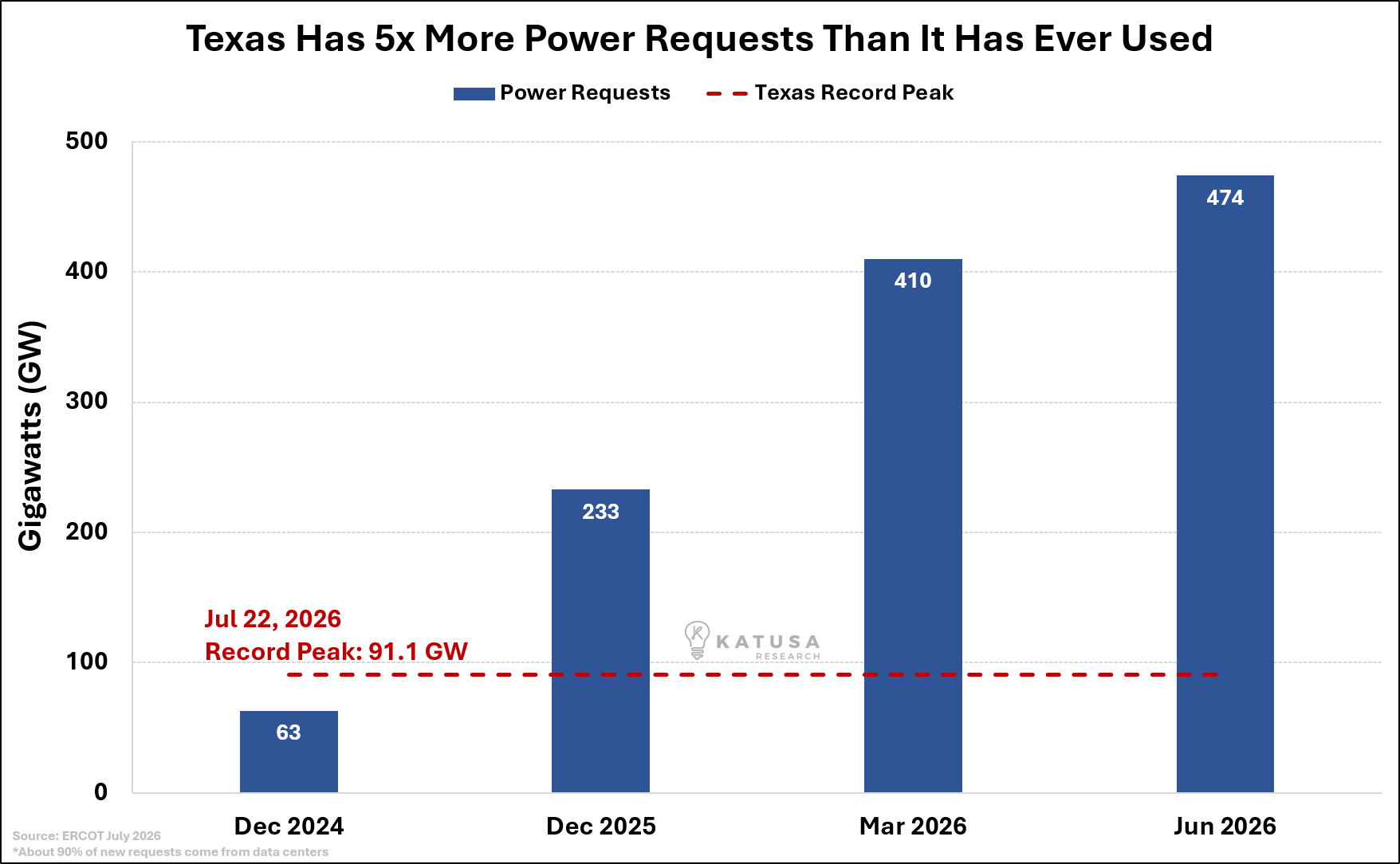
Of that 474, the operator had cleared 9.5 gigawatts to connect, and in July it could see 4.4 gigawatts actually drawing power.
- Texas has over a hundred gigawatts on paper for every one that is drawing power. Those are Paper Gigawatts.
On August 3, Governor Abbott told the grid operator to stop connecting new data centers until it had checked who was real.
ERCOT is auditing roughly 300 projects and reports back on December 10. A new state law goes further: from next year, only loads with a signed connection agreement count in the Texas forecast.
Ohio got there first.
AEP Ohio had more than 30 gigawatts of data center requests on its books. When it asked developers to pay for formal studies, 13 GW remained.
When AEP put binding contracts and financial commitments in front of them, 5.6 GW signed.
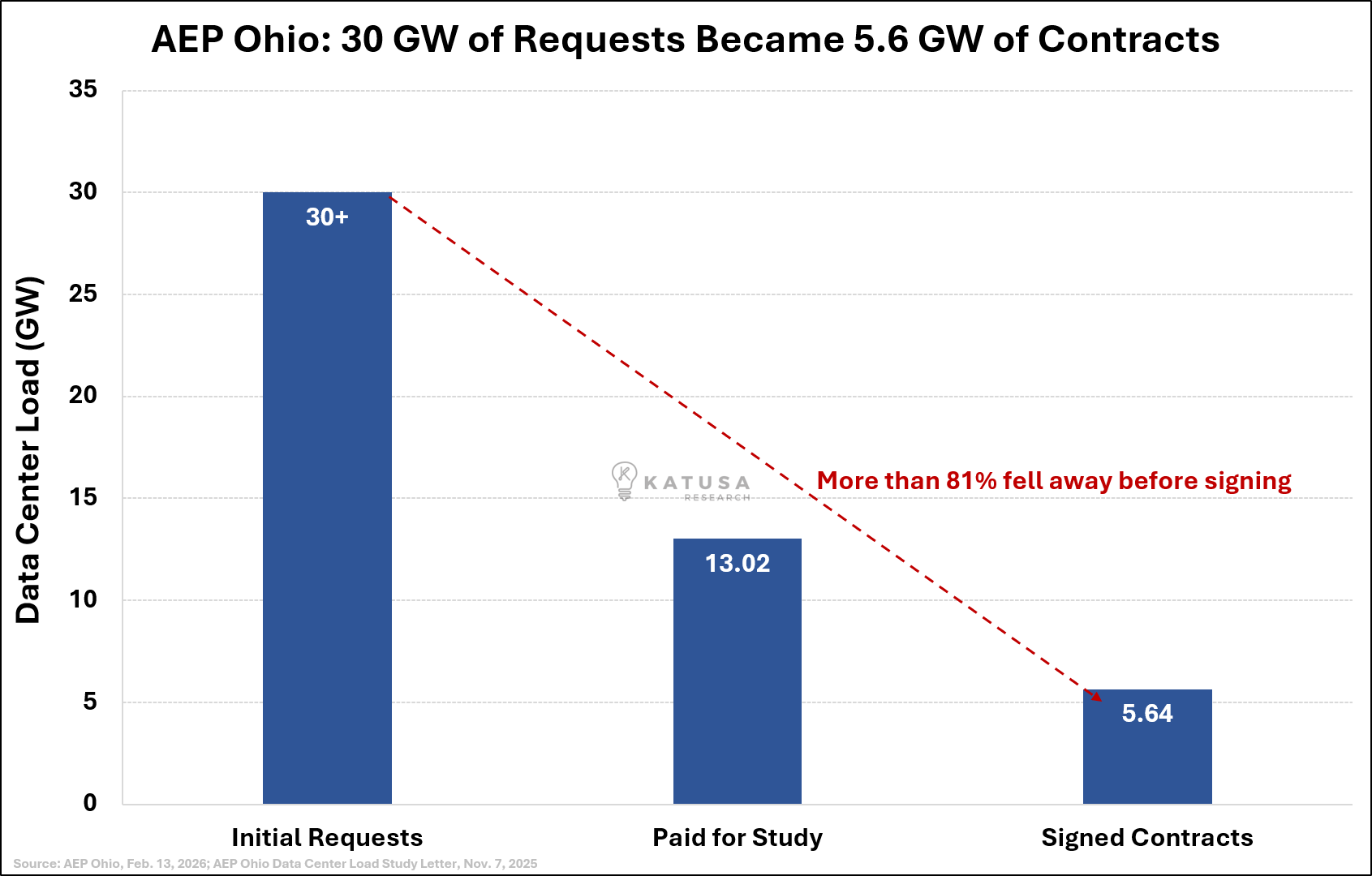
More than four out of every five requested gigawatts fell away before the contract stage.
The Forecast Chases the Last Surprise
In June 2025, S&P Global counted 117 gigawatts of American data center demand for 2030. It raised that count in September and again in April, to 183 gigawatts, and 2030 is no closer than it was.
The Energy Department's own lab tells the same story from the metered side. In 2023, it had data centers using under 5% of American electricity, with a top case of 12% by 2028.
This June it lifted the ceiling past 15% by 2030.
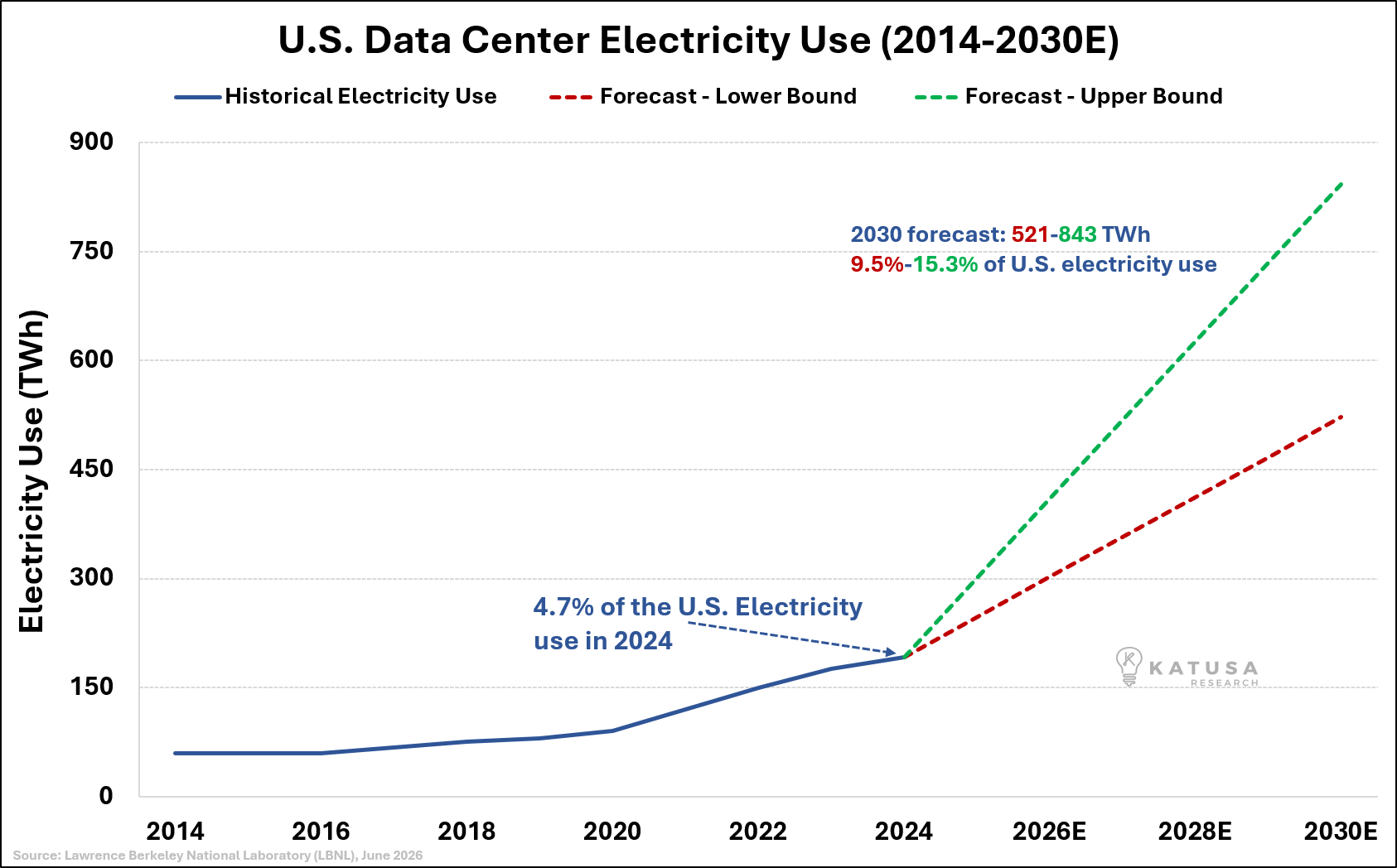
- The lab's 2030 range is 322 terawatt-hours wide, almost twice what every data center in America used in 2023.
Every forecaster corrects toward its last miss. The lithium crowd missed high and cut; the power crowd missed low and is still raising.

Utilities build to the raised number.
Gas capacity in their plans for 2035 has grown from 275 gigawatts to 350 since the end of 2022, by RMI's tally, and somebody pays for every plant in that plan whether the reservation shows or not.
S&P has a word for the stretch of a cycle where spending keeps rising after the earnings stopped supporting it overshoot. A forecast made of reservations is how a build gets there.
I Count What's Metered
On Monday, Google signed a 20-year deal with Constellation for 890 megawatts of new nuclear capacity on the PJM grid. The power comes from upgrades across eleven reactors, the first expected in 2028.
- That’s more than $4 billion, eleven reactors and a 20-year contract. These gigawatts have money behind them.
The paper gigawatts need a 2030 forecast to get paid. The reactors that already exist and the warehouses that are already down to days of stock do not.
The kitchens are buying steak on reservations.
I count the tables that are already full.
Regards,
Marin Katusa
Get real-time alerts right away. Follow on X: @KatusaResearch and @MarinKatusa
Details and Disclosures
Investing can have large potential rewards, but it can also have large potential risks. You must be aware of the risks and be willing to accept them in order to invest in financial instruments, including stocks, options, and futures. Katusa Research makes every best effort in adhering to publishing exemptions and securities laws.
By reading this, you agree to all of the following: You understand this to be an expression of opinions and NOT professional advice. You are solely responsible for the use of any content and hold Katusa Research, and all partners, members, and affiliates harmless in any event or claim.
If you purchase anything through a link in this email, you should assume that we have an affiliate relationship with the company providing the product or service that you purchase, and that we will be paid in some way. We recommend that you do your own independent research before purchasing anything.
This is an expression of opinion and not professional advice. Neither Marin Katusa nor Katusa Research are registered broker-dealers or financial advisors. Past performance is not indicative of future results. When investing in speculative stocks, it is possible to lose your entire investment.
© 2026 Katusa Research / New Era Publishing Inc.