
The 21 for 21 Streak
This year’s midterms come with a familiar setup.
- The 21-for-21 Streak: Stocks have climbed after every midterm since 1942. You'll see what gold and silver did.
- Silver’s Worst Start Since 1974: Six of the seven times silver went into a midterm down, it came out higher.
- Shopping Season is Coming: Tax-loss sellers are dumping mining stocks until December 31, and I’m making my list.
Six days before the 1978 midterms, Jimmy Carter announced an emergency plan to save a dollar.
The Dollar hit record lows against the German mark and the yen. So, the Fed raised its discount rate a full point to 9.5% and the Treasury lined up $30 billion of foreign currency to buy dollars.
Then the Treasury promised to auction 1.5 million ounces of gold a month from December.
The Dow jumped 4.5% that day, its biggest one-day point gain ever, after losing nearly 12% in the two and a half weeks before.
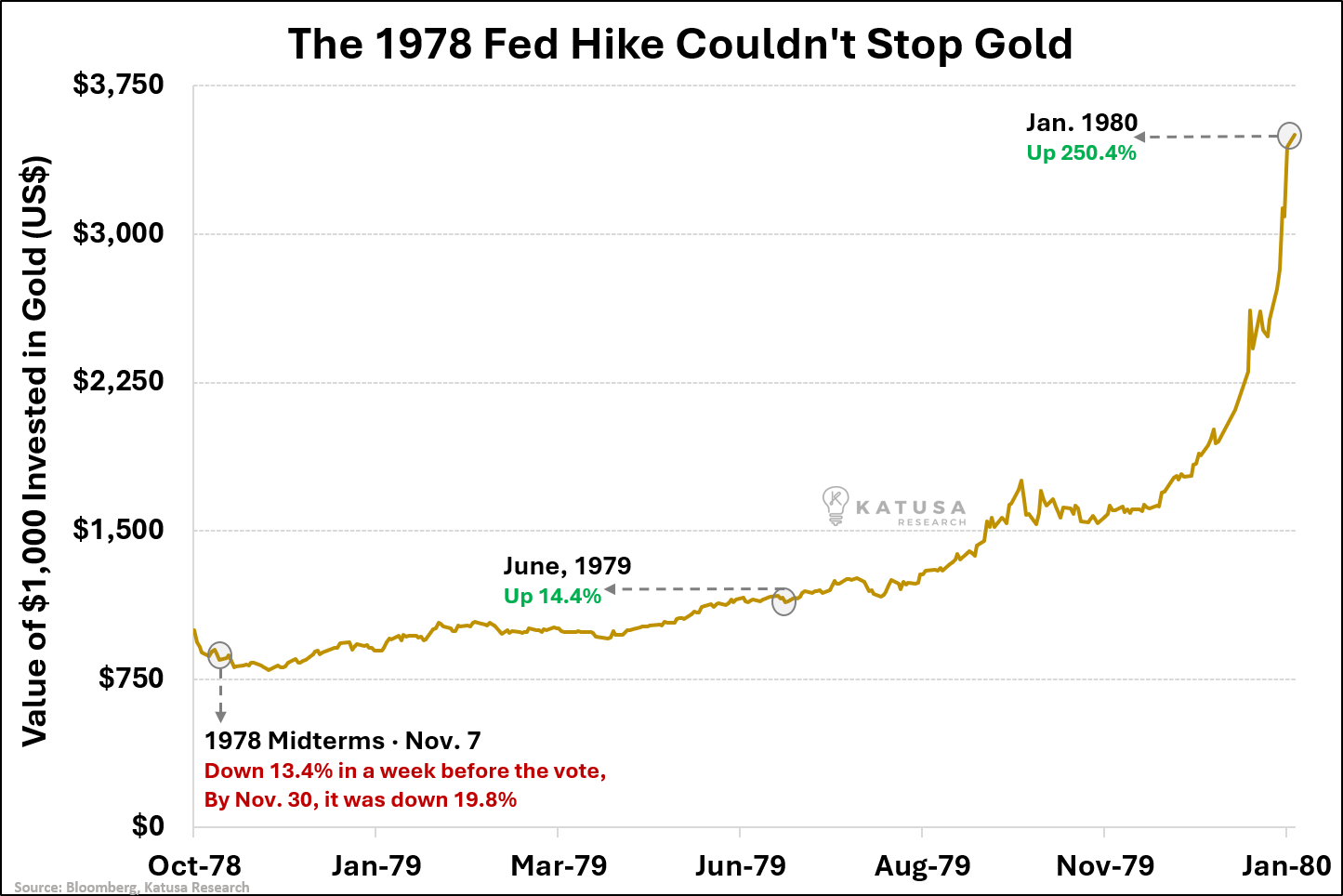
Gold lost a fifth of its value between Halloween and the end of that November.
Say you held $1,000 of gold that Halloween. A month later you had $797.
Washington was about to sell gold into your position every month, and the Fed just told you rates were going higher.
- Eight months after the vote, that $1,000 was $1,144. By January 1980 it was $3,500.
Inflation kept climbing anyway, and gold went with it.
The Fed raised rates in September and paused last week, with two members voting to go again. Meanwhile, gold and silver walked into the vote already beaten down.
Eight Months After the Vote
Since 1942, the S&P 500 has risen in the eight months after every midterm vote, 21 for 21. The 1978 window was a weak one at 10.5%, and gold beat it.
- Our gold and silver study goes back to 1974, 13 midterms in all.
- But they rarely beat stocks, less than a third of the time.

Here’s every midterm since 1974 on one page. Silver’s average is double its typical year.

A rate hike pays you more to hold a Treasury and nothing more to hold an ounce. Add a dollar rescue and a gold auction schedule, like in November 1978, and gold lost 20% in a month.
Over the eight months after a midterm, the hike mattered less than who kept buying through it. You can see where I’m going with this…
In 1994, inflation sat under 3%, the Fed hiked twice through those eight months, and gold finished flat.
In 2010, the Fed became the buyer. The day after the vote, it said it would create $600 billion of new money to buy Treasuries. By June, gold was up 10%, and silver was up 40%.
In 2022, inflation opened the window at 7.7%, central banks bought more gold than in any year since 1967, and gold gained 17.5% through five hikes.
Who’s Buying Now?
The day after the midterms, gold jumped 3.3% and silver almost 5%, as the dollar slipped. Oil dropped 8% on hopes of an Iran deal, and traders still expect the Fed to hike again in December. That bounce started from a one-year low.
By the end of October, gold was more than a quarter below its January high. Silver had lost more than half from its high and almost a third on the year.
- Silver hasn’t gone into a midterm this beaten up since at least 1974. Six of the seven times it went in with a loss for the year, it came out higher eight months later.
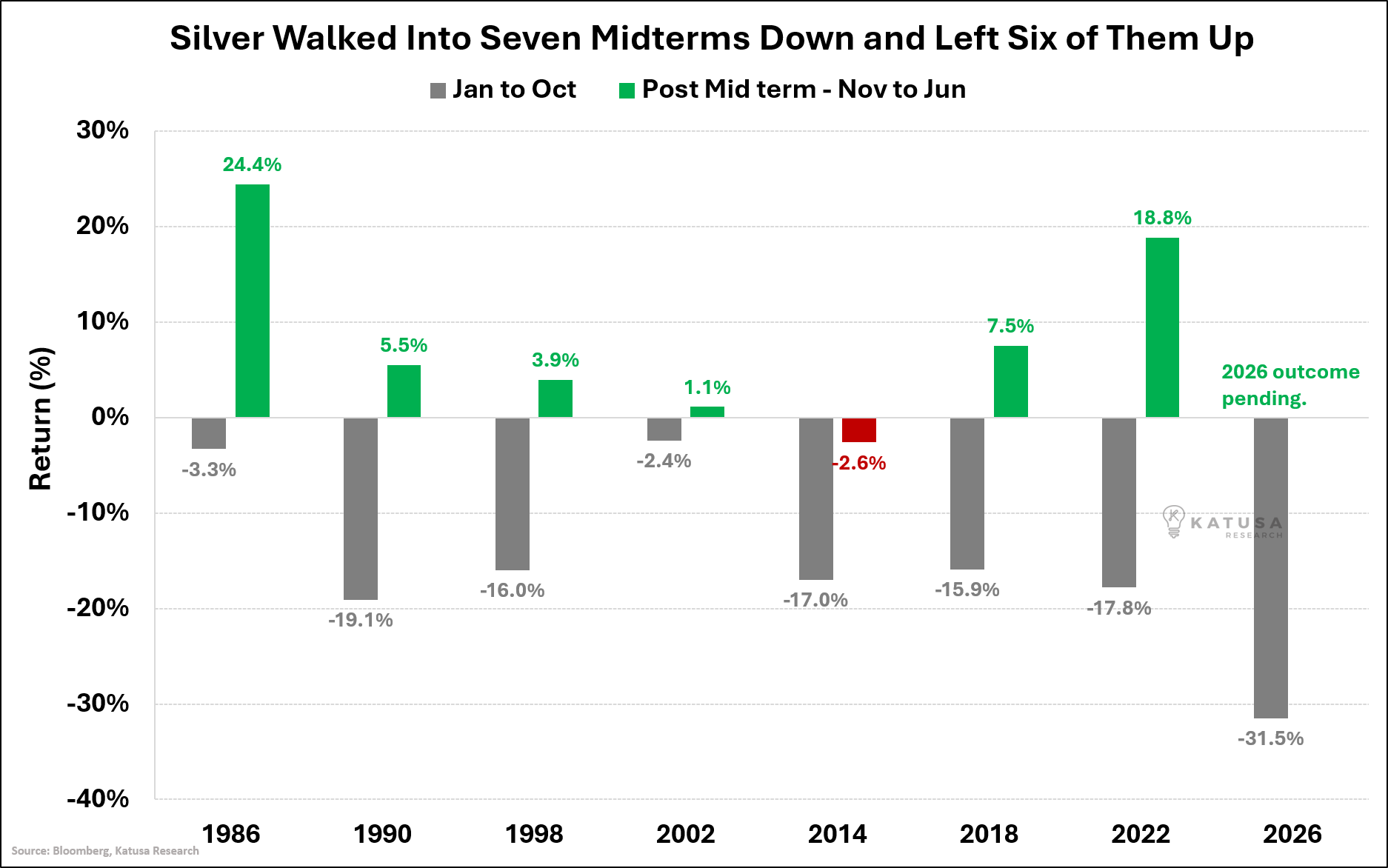
Even in most of those winning years, silver dropped 10% or more at some point before it came back.
Into this year’s correction, the biggest buyers on earth kept buying. From July to September:
- Central banks bought 10.3 million ounces of gold, up 42% from a year ago.
- Gold ETFs added 6.78 million ounces, a record $31 billion for a single quarter.
Central banks and funds are still buying the metal. The people selling mining stocks right now are racing the taxman, and they have until New Year’s Eve.
Shopping Season is Coming
In 1978, the seller was the Treasury, auctioning 1.5 million ounces a month on a published schedule, selling straight into a tripling.
This year’s seller is anyone booking a tax loss on a losing mining stock, and the last day to do it for 2026 is December 30 in Canada and December 31 in the U.S.
The Fed meets on December 8 and 9, three weeks before that deadline. So a hike and the forced selling could land in the same month, like 1978 on a shorter clock.
A junior with cash for its next drill program goes out the door for the same reason as one that must raise money to keep the lights on.
Tax-loss selling makes cheap stock cheaper and a bad stock look cheap.
For the next eight weeks, you can buy good companies from people who are selling to cut their tax bill.
In 1978, the Fed hiked, the metals fell first, and the investor who had sized for that drop tripled his money by January 1980.
Before you buy anything, write down why you own each position, how big a hit you can stomach in a bad week, and what would make you sell. Then size each one so you can sit through a 1978 start.
Make your list now and buy only when the forced seller shows up.
- In Katusa’s Resource Opportunities, we are tracking two gold opportunities for this window, and one of them fits tax-loss season perfectly.
To see both before the selling starts:
Regards,
Marin Katusa
Get real-time alerts right away. Follow on X: @KatusaResearch and @MarinKatusa
Details and Disclosures
Investing can have large potential rewards, but it can also have large potential risks. You must be aware of the risks and be willing to accept them in order to invest in financial instruments, including stocks, options, and futures. Katusa Research makes every best effort in adhering to publishing exemptions and securities laws.
By reading this, you agree to all of the following: You understand this to be an expression of opinions and NOT professional advice. You are solely responsible for the use of any content and hold Katusa Research, and all partners, members, and affiliates harmless in any event or claim.
If you purchase anything through a link in this email, you should assume that we have an affiliate relationship with the company providing the product or service that you purchase, and that we will be paid in some way. We recommend that you do your own independent research before purchasing anything.
This is an expression of opinion and not professional advice. Neither Marin Katusa nor Katusa Research are registered broker-dealers or financial advisors. Past performance is not indicative of future results. When investing in speculative stocks, it is possible to lose your entire investment.
© 2026 Katusa Research / New Era Publishing Inc.