
The Big Uranium Discount
Your shares fell while utilities paid a record price.

Say you run the fuel desk at an American utility.
An investor asks what you think of the spot price, and you look at him like a tourist.
Your bonus depends on one thing: every reactor gets its fuel on time. If one runs short, nobody remembers what you saved per pound.
This summer, desks like yours paid a record price to lock in uranium.
If you own uranium stocks, your shares went the other way.
The last time buyers paid this much, it took a flood.
On October 22, 2006, water broke through a rock wall 465 metres under northern Saskatchewan.
It filled the richest uranium mine ever found. Cigar Lake was built to supply a tenth of the world’s uranium, and it took almost eight years to produce its first pound.
Utilities had spent the 1990s running down inventories and feeding reactors on dismantled Soviet warheads. Now the mine that was going to refill them was a lake.
Spot ran from $56 to $136 in eight months.
The contract price set a record of $95 that stood for nineteen years.
- The contract price passed $95 in June and reached $96.50 in August. And no mine flooded this time.
The buyers ran out of calendar.
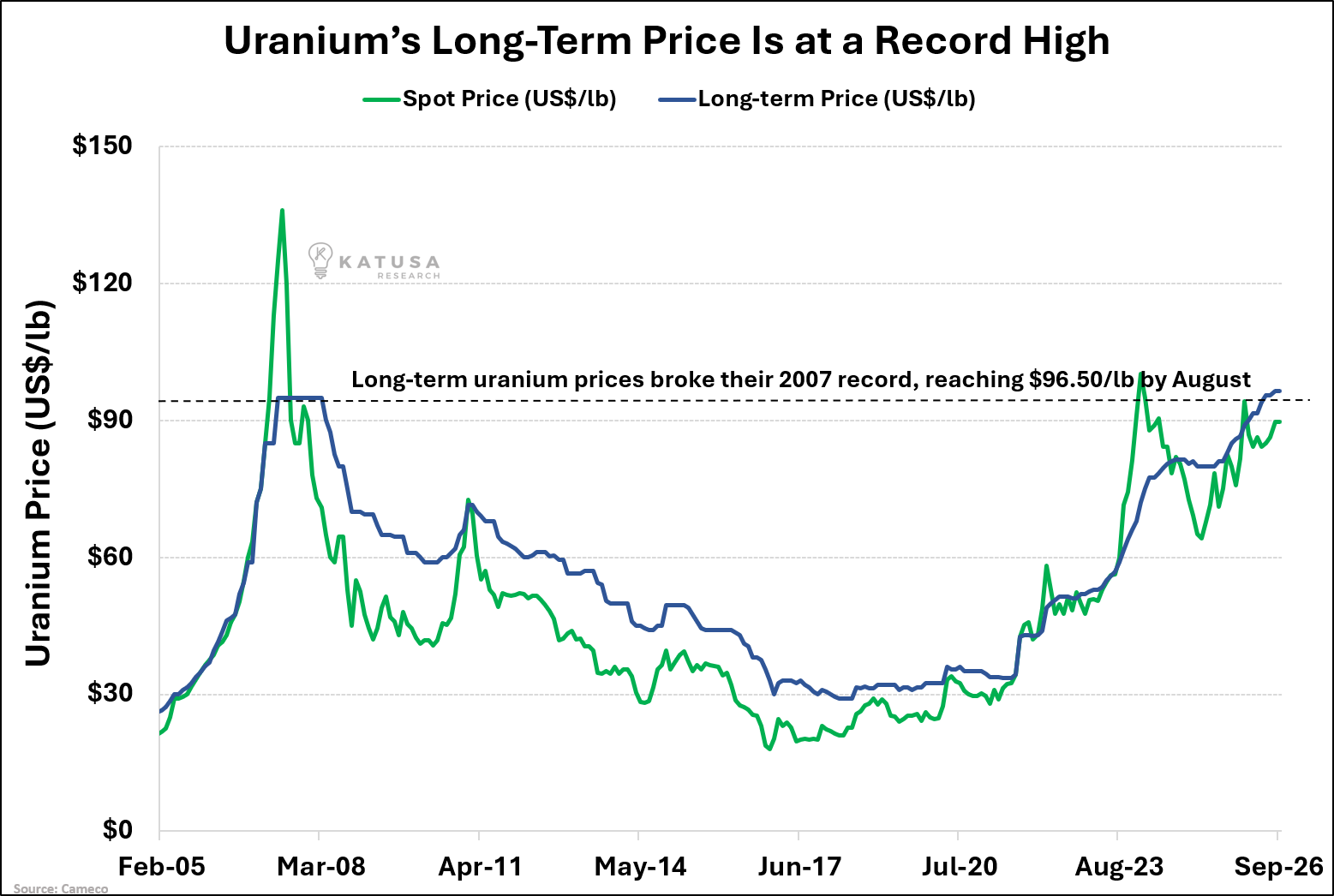
Spot ended September below the term price. Utilities will pay more for the 2030s than for a pound today.
Miners Won’t Dig Until You Sign
For most of a decade, the miners and the utilities have sat across a table, each waiting for the other to move.
Kazatomprom, the largest producer on earth, cut its permitted 2026 production ceiling from about 85 million pounds to 77 million. It said uncovered demand did not justify running at full capacity.
Cameco only mines what it has already sold under contract.
- If utilities want more pounds from either of them, they sign first.
The utilities have inventories to buy them time.
Over the past five years, the world’s reactors consumed 815 million pounds while utilities signed new long-term contracts for just 589 million.
Uranium on Empty
The EIA tracks how much uranium American utilities already have under contract. This year the calendar is full.
By 2034, it is nearly empty.
- Unfilled requirements climb from 1 million pounds this year to 37 million in 2034, and the reactors burning them are already built.
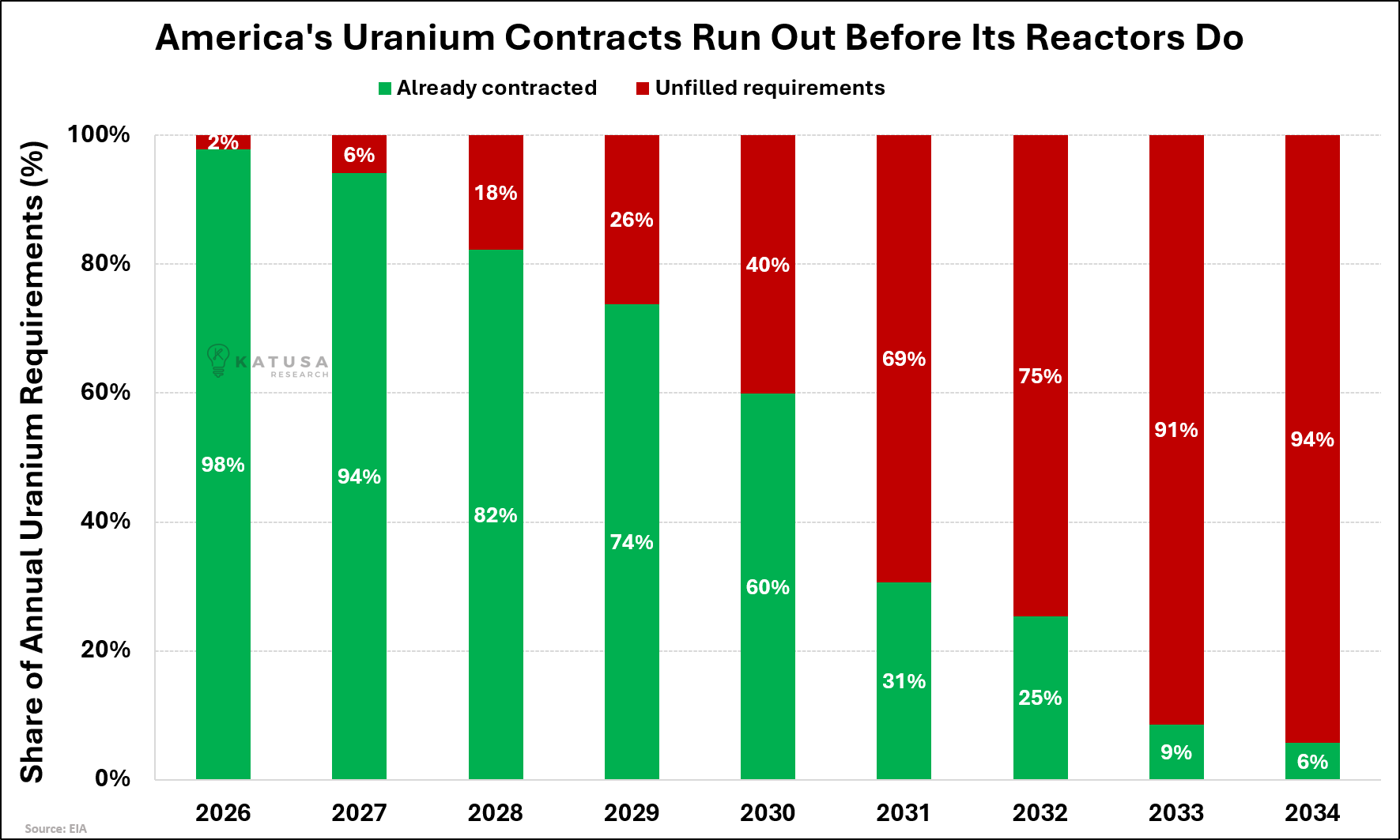
A pound ordered today spends years in conversion, enrichment and fabrication before it reaches a reactor. So, the early 2030s get booked in the next two or three years.
Back at that fuel desk, waiting for a lower price now means waiting against your own refuelling dates.
Uranium Pounds Are Going East
In 2006, the missing pounds went underwater from the flood.
Today, they are going to China.
On October 7, Kazatomprom’s shareholders approved a supply contract with a unit of China’s State Power Investment Corporation, delivered to the railhead at Alashankou. Eighty-nine percent voted in favour.
A second contract, with Rosatom’s Uranium One, failed when 88% of the shares abstained. Volumes and prices on both stay confidential.
- Kazakhstan digs about two pounds in every five mined on earth.
The pounds it signs away to China come out of the same pool a Western utility has to book from.
Then on January 1, 2028, Russian enrichment leaves the American market for good.
- Russia holds about 44% of the world’s enrichment capacity.
The empty years in the 2030s have to be filled from a pool shrinking at both ends, the mine and the enricher.
Two Things Broke Uranium Stocks…
And neither was the metal.
First, the crowd that piled into uranium stocks over the past two years was buying an AI story.
Reactor startups and miners traded as one bet on data-center power, and when that bet cracked this month, they all left by the same door.
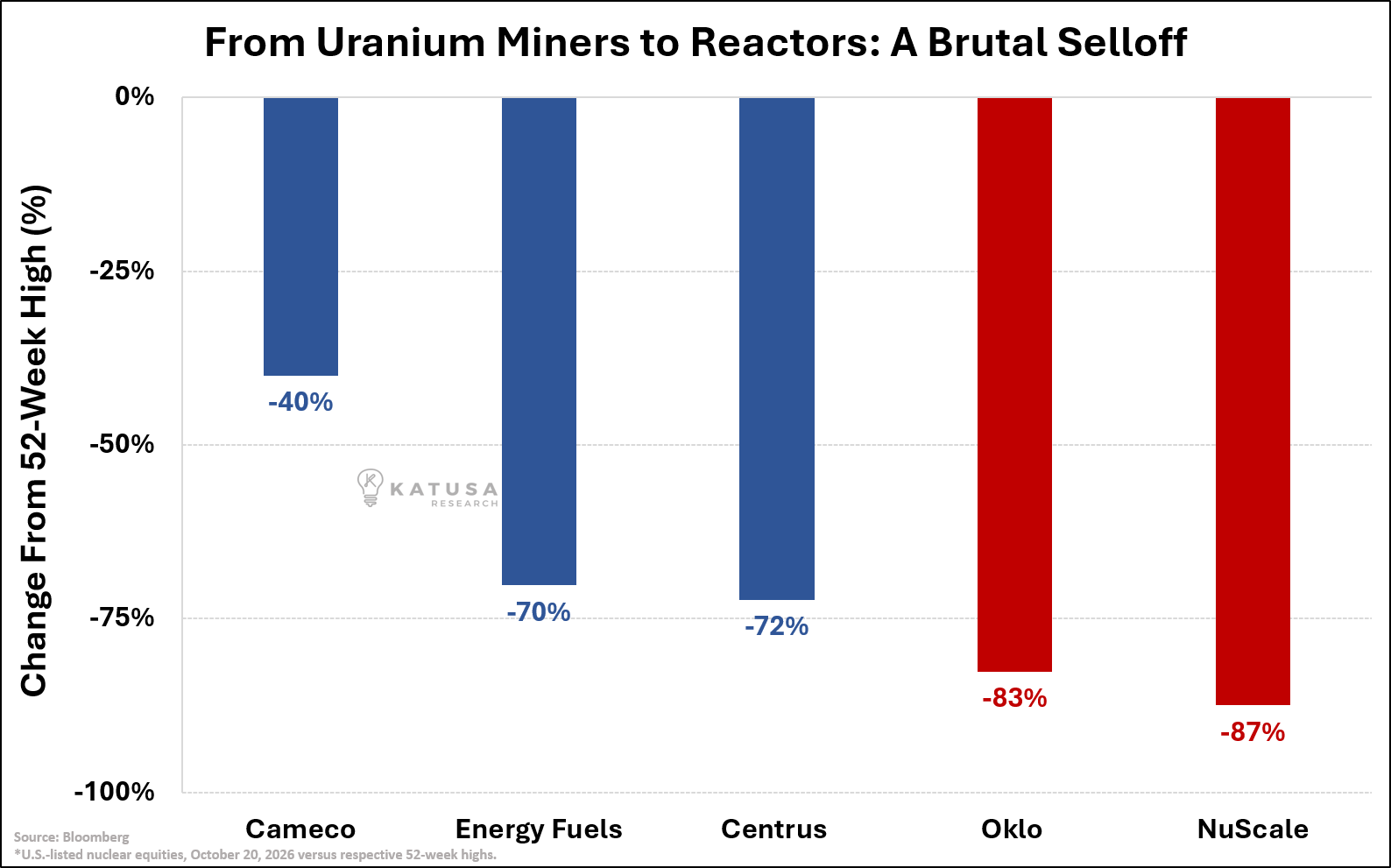
- The names on the left sell pounds and fuel under contract.
- The names on the right sell plans.
Second, the profits are late and the costs came early.
Cameco gets paid more per pound than a year ago, but its costs rose faster and it delivered fewer pounds, so gross profit fell 27%.
Sellers read that as a broken thesis, but Katusa Research reads it as a paycheck stuck in the mail.
Fuel desks set the term price and I call it the Delivery Price: the number paid by the men who have to take the pounds and answer for the lights.
- On October 20, the Sprott Physical Uranium Trust, holding about 81.7 million pounds, traded 12.6% below the value of the uranium inside it.
Paper pounds sold at a discount while fuel desks paid a record.
In 2006, It Took a Flood to Make Buyers Move…
This time it takes a calendar and a border, and both are already set.
None of this makes the stocks safe. If the Delivery Price rolls over, this argument fails.
So sort what you own into two rooms. One sells pounds under contract and reprices toward a record. The other sells plans and borrowed nuclear’s name for an AI rally.
Only one has a fuel buyer on the other side of the trade.
Somewhere a fuel buyer has to sign for the 2030s. His bonus depends on fuel arriving on time, and he will pay the price that gets it.
Uranium stocks are coming into alligator-buying territory.
And I’m cashed up to go hunting.
Regards,
Marin Katusa
Get real-time alerts right away. Follow on X: @KatusaResearch and @MarinKatusa
Details and Disclosures
Investing can have large potential rewards, but it can also have large potential risks. You must be aware of the risks and be willing to accept them in order to invest in financial instruments, including stocks, options, and futures. Katusa Research makes every best effort in adhering to publishing exemptions and securities laws.
By reading this, you agree to all of the following: You understand this to be an expression of opinions and NOT professional advice. You are solely responsible for the use of any content and hold Katusa Research, and all partners, members, and affiliates harmless in any event or claim.
If you purchase anything through a link in this email, you should assume that we have an affiliate relationship with the company providing the product or service that you purchase, and that we will be paid in some way. We recommend that you do your own independent research before purchasing anything.
This is an expression of opinion and not professional advice. Neither Marin Katusa nor Katusa Research are registered broker-dealers or financial advisors. Past performance is not indicative of future results. When investing in speculative stocks, it is possible to lose your entire investment.
© 2026 Katusa Research / New Era Publishing Inc.