The SpaceX Launch Tax
The “Launch Tax” and why SpaceX may become the largest IPO in history.

Quick test for Friday morning.
If SpaceX opens 40% above the indicated IPO price, did the business improve 40% before lunch?
I don’t think the rockets got forty percent better between your alarm and the opening bell.
That difference between what the company is worth and what your order says you paid, is the whole game inside the most-watched deal on the planet.
I’ve sat on the other side of it a few hundred times, in financings one-thousandth this size in resource markets.
- SpaceX is expected to offer 555.6 million shares at an indicated $135 per share.
That’s almost exactly $75 billion of gross proceeds.
If the underwriters use the full overallotment option, the raise can reach $86.25 billion.
At that price, the company is worth about $1.77 trillion before a single public share even trades.
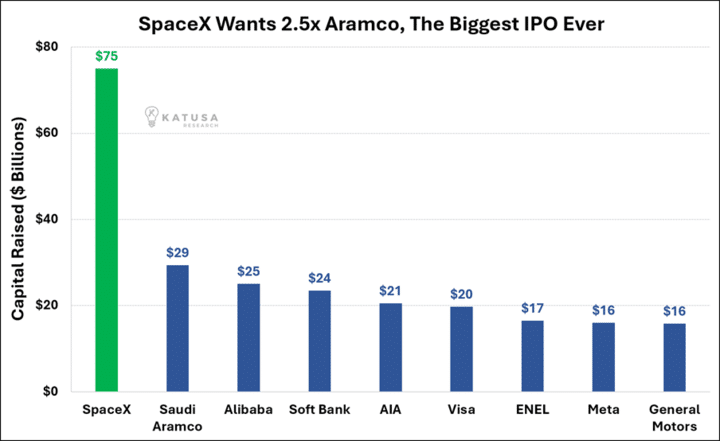
Nothing on record is a close second place – not even the previous most valuable company on the planet, Saudi Aramco.
In fact, SpaceX’s base raise alone beats Aramco, ENEL (Italian Energy Corporation), and Meta combined.
The Crowd Has the Easy Part Right
SpaceX matters.
Starlink beams WiFi into homes around the world, reusable rockets changed launch economics, and Starship could change them again. Add defense contracts, AI infrastructure, and Elon Musk’s capital-market gravity, and investors feel late before the stock even opens.
Feeling late is expensive.
A record-setting IPO tells you the company can command capital. It also tells you the company chose a generous market.
Issuers sell when the story is strong, the order book is deep, and the price can absorb ambition.
That makes the deal historic.
It also makes the first public hour dangerous.
The implied valuation is about $1.75 trillion. SpaceX reported about $18.7 billion of 2025 revenue and a net loss. At the IPO price, investors are looking at a revenue multiple near 90 times before any first-day markup.
A stock can deserve a premium and still punish the first buyer who pays for every future win before the first quarterly call.
Call it the Launch Tax.
The Launch Tax is the premium investors pay when scarcity, headlines, and regret get added to the quote.
You can see the tax before the stock even trades.
Who’s Allowed to Sell you SpaceX
SpaceX may sell less than 5% of the company in the IPO.
That small float can make Friday look easy. If enough buyers crowd into a thin window, the price can levitate.
The important question is who wants liquidity?
- Google wrote SpaceX a $900 million check in 2015, when the company was worth about $10 billion.
At this IPO valuation, that stake has become one of the most valuable private-company positions on earth.
When a decade-old private stake finally gets a public exit ramp, you should ask who needs liquidity as much as who wants exposure.
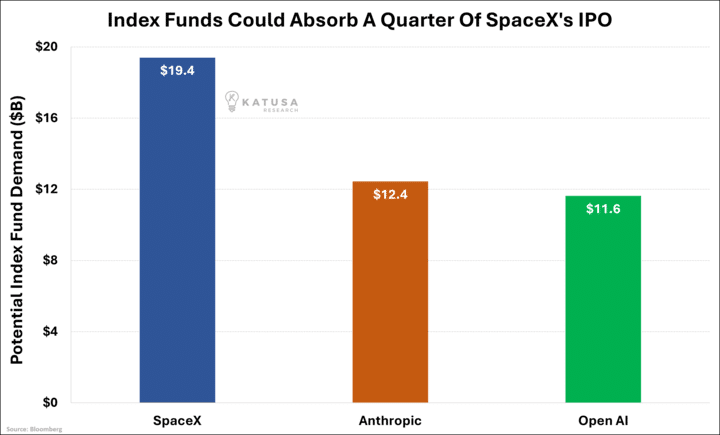
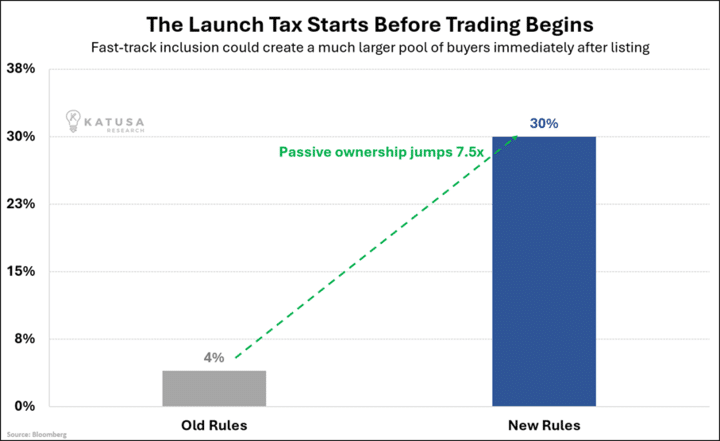
Fast-tracked index inclusion could put 30% of the float in passive hands within 15 days, compared to 4% if traditional rules of inclusion were followed.
Reuters reported that SpaceX is considering a large retail allocation and unusual insider liquidity in stages. Elon Musk also keeps overwhelming voting control after the deal.
- SpaceX is selling less than 5% of itself.
- Through dual-class shares, Musk’s 42% equity stake gives him 79% of voting power.
It’s an auction for a souvenir, run by the most eager buyers in the room.
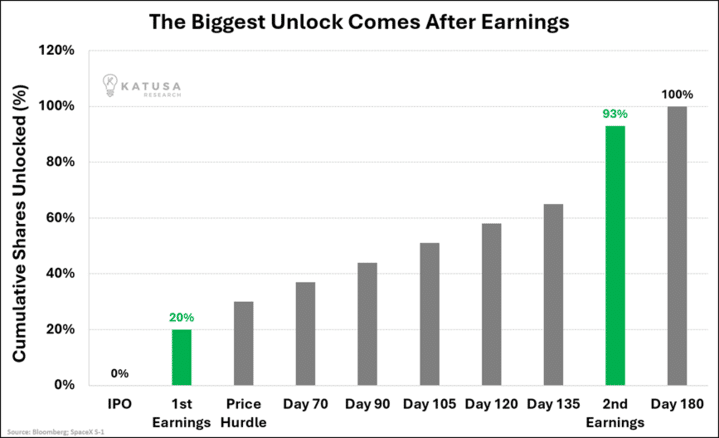
And then the calendar takes over, where Musk and the largest backers are locked for 366 days.
Everyone else comes free in seven percent slices at 70, 90, 105, and 120 days, with more tied to earnings, have a look:
Retail demand can help lift the first few trades, especially if SpaceX employees are not the only ones looking for liquidity.
- Add in the possibility of index buyers and a small float, and the stock can squeeze higher fast.
The setup is built for emotion, and usually where regular investors make the wrong trade. It’s easy to turn a 10-year thesis into a one-hour order. They let the opening print decide position size. They confuse participation with conviction.
The discipline is not complicated… just separate access from allocation.
An IPO fill is not a mandate to build the whole position before lunch.
The Friday Rule
The question is not whether SpaceX becomes important – it already is.
It’s how much of your 2036 position belongs in the first public hour.
- For most regular investors, the discipline is simple and psychologically difficult: separate access from allocation, and separate story quality from execution price.
Like an alligator investor, keep enough cash to stay useful if the Launch Tax fades.
The market is about to hand you a 95-times-sales bet on AI infrastructure wearing a rocket company’s name.
The biggest returns in that race won’t land on the most hyped logo…
They’ll land on the un-hyped suppliers that get paid no matter which AI wins: the power, the metal, the fuel, the grid.
SpaceX may become one of the most important public companies in the world.
Regards,
Marin Katusa
Get real-time alerts right away. Follow on X: @KatusaResearch and @MarinKatusa
Details and Disclosures
Investing can have large potential rewards, but it can also have large potential risks. You must be aware of the risks and be willing to accept them in order to invest in financial instruments, including stocks, options, and futures. Katusa Research makes every best effort in adhering to publishing exemptions and securities laws.
By reading this, you agree to all of the following: You understand this to be an expression of opinions and NOT professional advice. You are solely responsible for the use of any content and hold Katusa Research, and all partners, members, and affiliates harmless in any event or claim.
If you purchase anything through a link in this email, you should assume that we have an affiliate relationship with the company providing the product or service that you purchase, and that we will be paid in some way. We recommend that you do your own independent research before purchasing anything.
This is an expression of opinion and not professional advice. Neither Marin Katusa nor Katusa Research are registered broker-dealers or financial advisors. Past performance is not indicative of future results. When investing in speculative stocks, it is possible to lose your entire investment.
© 2026 Katusa Research / New Era Publishing Inc.