The Tax on Standing Still
You missed the split point on the letter “K”.
Somebody you love thinks this is the best economy of their lifetime.
Somebody else you love can’t get through August without a credit card.
And you’ve sat between them at the same table, nodding at both, wondering which one was lying to you.
Neither one was.
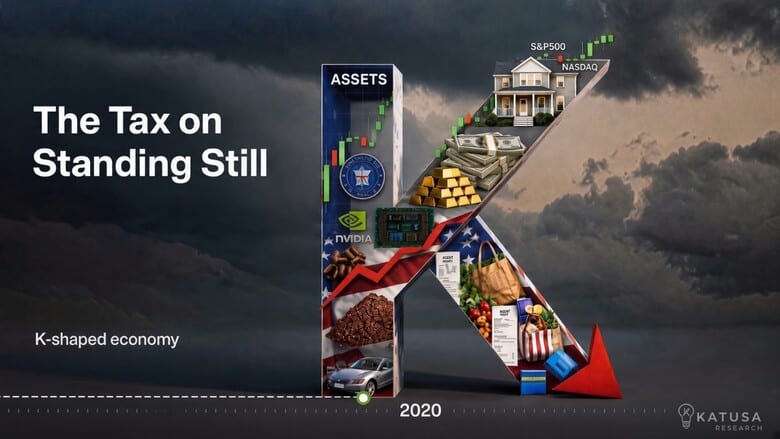
In 2020, the American economy stopped being one economy. Economists named the break: the K-shaped economy.
One Letter Sorted 132 Million Households
Picture the letter K: one line drops, then splits into two arms.
One arm climbs and the other sinks.
In 2020, Washington cut rates to zero and grew the money supply roughly 40% in two years. All that new money landed on things you can own.
If you owned stocks or a house, the flood lifted you.
The S&P 500 sits near record highs, and American home prices are up almost 58% since the start of 2020.
If you owned rent and groceries, the flood lifted your bills instead.
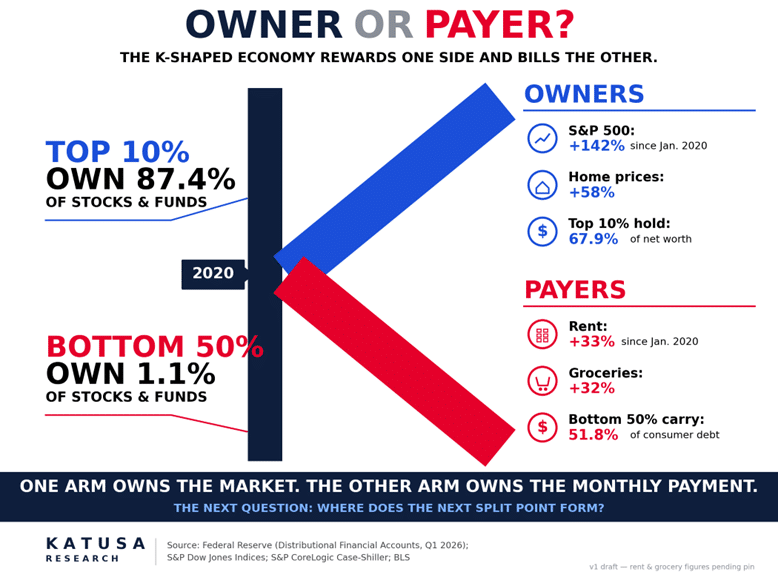
If you want to know, the Federal Reserve keeps score.
The top 10% of households own 87% of all stocks. The bottom half owns 1% and carries more than half of America’s consumer debt.
The upper arm does what the lower arm can’t: turn surplus cash back into assets.
The lower arm’s next dollar increasingly goes toward:
food → rent → power → transportation → necessities
The upper arm’s next dollar increasingly goes toward:
assets → property → investments → premium services → scarcity
Every K Has a Split Point
A K is two arms and one moment.
And the moment one line becomes two is what I call the split point.
The 2020 split point was the money flood. The people who rode the upper arm never saw it coming. They were holding assets on the day the arms separated.
You can’t join an arm after it separates, but every new split point re-sorts everyone. The same re-sort ran after 2001, 2008, and 2020.
A real world example…
- In 1960, a median American house cost two years of household income. Today it costs more than five.
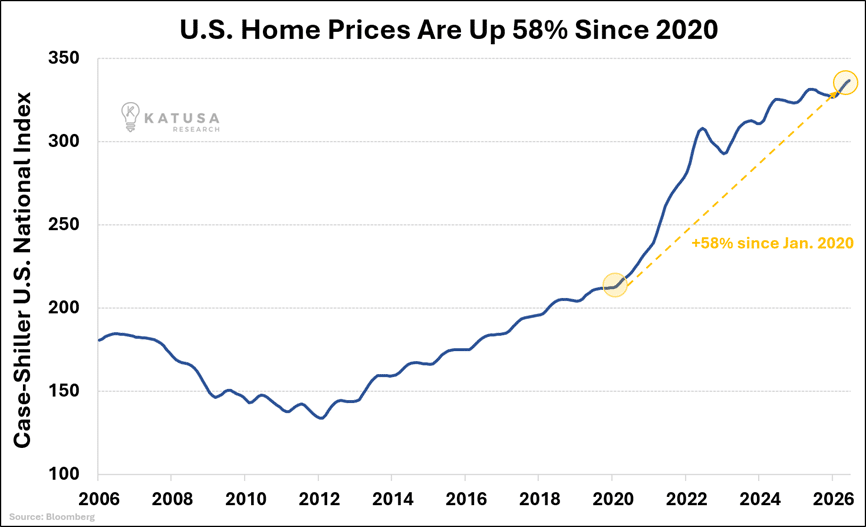
At these prices, buying the last K’s winners means paying full fare to the people who boarded early.
The Pentagon Already Picked Its Arm
One arm spends more of every new dollar paying for scarce things.
The other has enough capital to own them.
Measured against the S&P 500, broad commodities spent the early 2020s at their cheapest level in half a century.
I’ve published that ratio chart since 2019, and its two previous lows, in the early 1970s and late 1990s, each opened a decade of commodity gains.
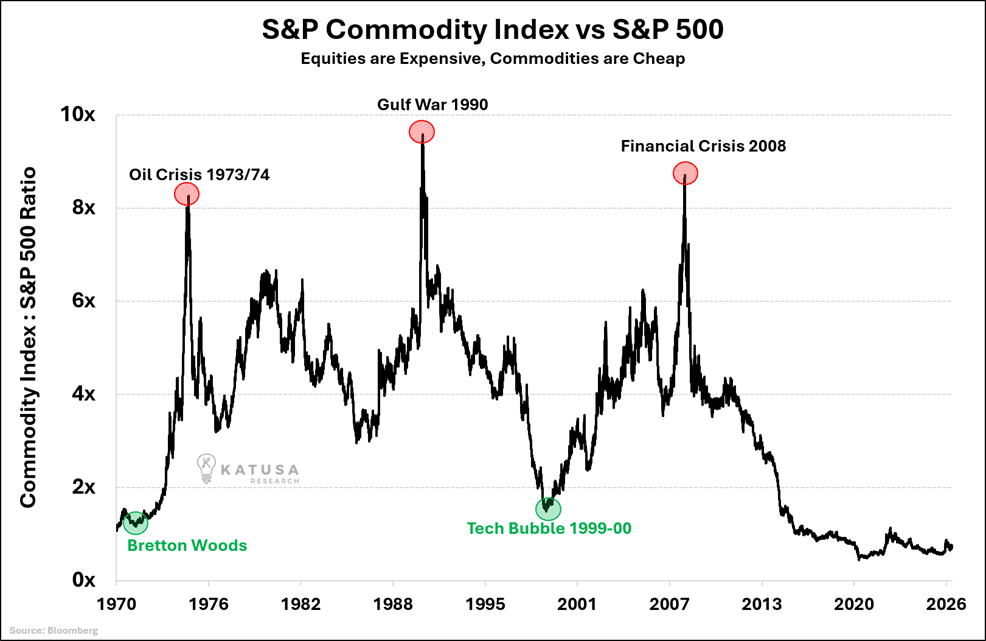
The turn has started: the broad commodity index hit an 18-year high this spring and sits 47% above a year ago. While the ratio still scrapes along the floor of its range.
Most readers of Katusa’s Investment Insights already sit on the upper arm.
The question is which part you own.
Nvidia alone carries more weight in the S&P 500 than energy, utilities, and materials combined. Your index owns the customer, but it barely owns the supplier.
- AI companies can design a chip in California, but they can’t code a megawatt into existence.
Data centers burned 415 terawatt-hours in 2024. The IEA sees 945 by 2030 and a 30% copper shortfall by 2035 on today’s pipeline.
Washington noticed before your feed on X or Facebook did. The Pentagon bought shares in America’s only operating rare earth mine in July 2025 and became its largest shareholder.
- In August 2026, it signed another $2 billion in critical minerals and battery deals.
Governments don’t spend billions on supply they expect to stay cheap…
How the Upper Arm Stays There
I found my first split point as a schoolteacher grading math quizzes at night.
A paycheck stops the minute you put the pen down, but the assets I started buying did not.
You don’t even need upper-arm money to start. That’s what a split point means: you’re early, so prices are still normal, and a regular paycheck can still buy a real position. The expensive part is waiting.
Run the math on standing still (and doing nothing)…
At 4% inflation, prices climb about 50% in a decade, and $100,000 of today’s buying power shrinks to about $67,000.
- In the University of Michigan’s latest survey, only 8% of Americans expect their pay to beat inflation this year.
That’s the tax on standing still.
The upper arm owns things that reprice with inflation instead of holding the cash that inflation eats.
A financing, for example, runs the other direction…
The company creates new shares and sells them to you directly. The money goes into the company itself, and these deals usually staple on a sweetener: a warrant, the right to buy more shares later at a locked price.
I’ve been in these rooms for over 20 years.
The open market is where the upper arm sells, and the financing is where it buys.
I put my own money into these deals, and members see the ones I’m in.
Some doors have rules about who walks through, and plenty of deals behind them go to zero. But you can’t walk through a door you’ve never heard of.
- One of our recent gold deals in Katusa’s Resource Opportunities is up 54% in the last few months.
And it could climb a lot further as the company executives its business plan. (High risk, high reward).
Staying on the top of the K hasn’t changed since 1960…
Own what reprices, buy near the split point, and use the best door your rules allow.
But being right about gold, oil or copper won’t save you if you own the wrong company in that sector.
That’s why Katusa’s Resource Opportunities exists.
It’s tailored to people who want the information and the names that the upper arm of the “K” are looking for.
Regards,
Marin Katusa
Get real-time alerts right away. Follow on X: @KatusaResearch and @MarinKatusa
Details and Disclosures
Investing can have large potential rewards, but it can also have large potential risks. You must be aware of the risks and be willing to accept them in order to invest in financial instruments, including stocks, options, and futures. Katusa Research makes every best effort in adhering to publishing exemptions and securities laws.
By reading this, you agree to all of the following: You understand this to be an expression of opinions and NOT professional advice. You are solely responsible for the use of any content and hold Katusa Research, and all partners, members, and affiliates harmless in any event or claim.
If you purchase anything through a link in this email, you should assume that we have an affiliate relationship with the company providing the product or service that you purchase, and that we will be paid in some way. We recommend that you do your own independent research before purchasing anything.
This is an expression of opinion and not professional advice. Neither Marin Katusa nor Katusa Research are registered broker-dealers or financial advisors. Past performance is not indicative of future results. When investing in speculative stocks, it is possible to lose your entire investment.
© 2026 Katusa Research / New Era Publishing Inc.