

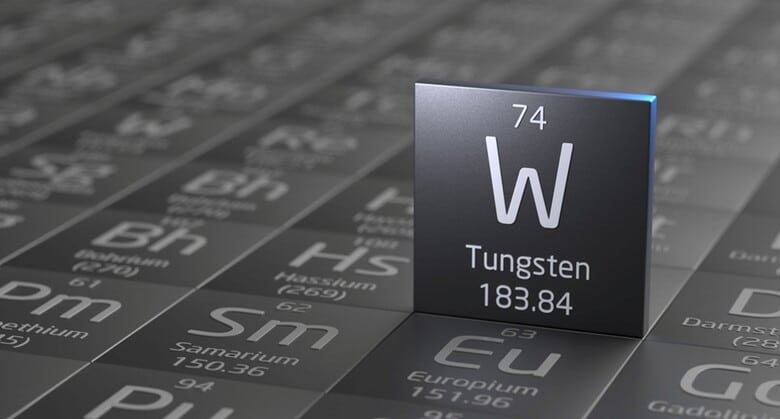
Your phone buzzed in your pocket this morning.
The tiny weight that made it shake is tungsten. So is the edge of the drill bit in your garage, the cutting tool that machined your car’s engine, and the core of an armor-piercing round.
You’ve held this metal a thousand times. Now try to buy it.
There’s no tungsten exchange or a futures contract and no fund that holds the metal.
The price is set by a handful of weekly assessments most investors never read, in a market so small that one government office can move it with paperwork.
That office sits in Beijing.
And over the past sixteen months, it taught the West a lesson I call the Permission Premium: the price you pay when a commodity requires someone else’s signature.
One Signature Took Tungsten from $390 to $3,400…
Start with what tungsten actually does, because almost nobody can say.
It’s the toughest working metal we have.
It carries the highest melting point of any metal and nearly the density of gold, which makes it the material of last resort: cutting tools, mining and drilling bits, aerospace parts, armor and munitions.
About 60% of American consumption goes into cemented carbide, the stuff that cuts everything else.
Now the supply side…
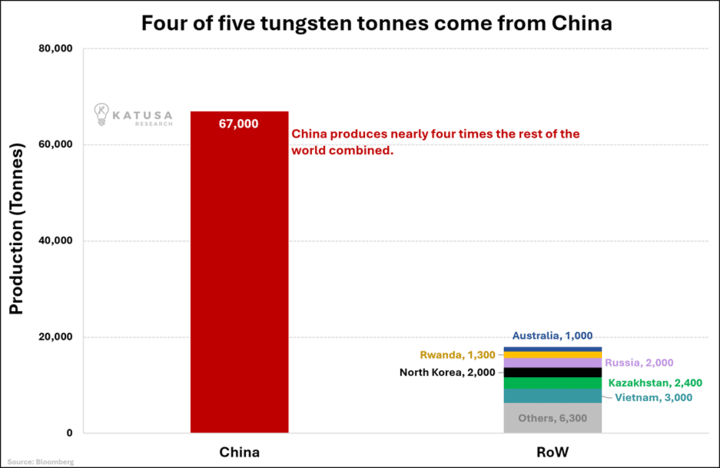
- China mined 67,000 of the world’s 85,000 tonnes last year, roughly 79%.
The United States hasn’t mined a single commercial tonne since 2015.
Most commodity markets have suppliers, but this one has a gatekeeper.
China’s $3,000 “Permission Slip”
In February 2025, Beijing put tungsten under export licensing.
It wasn’t a ban per se, but more of a permission slip. Where approvals sit in drawers and every Western buyer starts carrying extra inventory just in case.
China’s exports of APT, the intermediate product that becomes tungsten powder, fell almost 70% through the first eleven months of 2025.
The price did the rest…
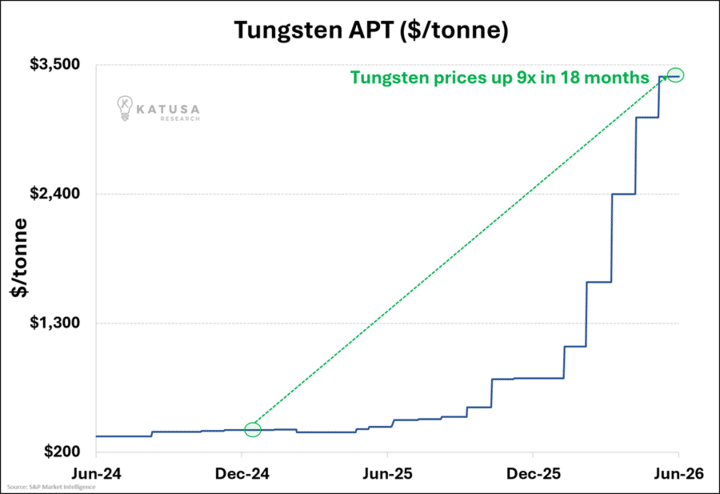
A license, after all, is a mine that produces delay. And the market spent the year pricing the delay. APT in Rotterdam started 2025 near $390 per metric ton unit.
This spring it printed around $3,400, roughly nine times higher in eighteen months, with violent swings along the way.
Tungsten Panic Buyers Arrive
The buyers showing up now don’t seem to care about price.
In May, Reuters reported the European Union shortlisted tungsten, alongside rare earths and gallium, for its first joint critical-minerals stockpile, with storage talks underway at Rotterdam.
Governments don’t buy because the chart looks cheap. They buy because the alternative is being caught empty, and they fix lateness with size.
The second buyer is stranger…
The Financial Times reported that Chinese traders have spent the past year working through American scrap yards.
Bidding for used carbide inserts, drill bits, and worn tooling, sometimes at five times normal market prices.
U.S. tungsten scrap is up 350% since May 2025. The metal itself is up 200%.
The waste is outrunning the metal.
My favorite detail in the whole story is that China bans tungsten scrap imports at its own border. So, the buying routes through recyclers in the Philippines, Taiwan, Vietnam, and South Korea, where the scrap becomes powder and product China can legally bring home.
- The country that controls 79% of the mines is quietly buying back the West’s garbage through four other countries’ furnaces.
On June 15th, China’s revised Mineral Resources Law took effect. Giving Beijing authority over total mine output, on top of quota cuts already squeezing its own smelters.
The wrong move is buying every junior with tungsten in the deck…
In a permissioned market, the prize isn’t the biggest deposit, or the prettiest map.
It’s the first tonne a Western customer can qualify without Beijing’s signature: feedstock under contract, processing on friendly soil, timelines measured in months.
The Sangdong mine in South Korea just restarted after thirty years dark, and buyers treated it like a lifeboat.
The scrap story is the part that keeps our attention.
The West spent decades shipping its used carbide overseas for pennies, and China just repriced that junk drawer at five times market.
Somebody owns those collection networks, those furnaces, those customer qualifications. Most of them aren’t public yet.
Most investors will read this and go buy the biggest tungsten deposit on a map. That’s the wrong tonne.
In a permissioned market, the only tonne worth owning is the one a Western buyer can take delivery of without Beijing’s signature: contracted feedstock, processing on friendly soil, timelines in months.
A handful of companies already clear that bar. Some of them aren’t public yet.
- The ones that survive our Survival Audit will land in Katusa’s Resource Opportunities first.
The next time your phone buzzes, remember what’s inside it.
A metal with no exchange, one gatekeeper, and a price that needed permission to exist.
Regards,
Marin Katusa
Get real-time alerts right away. Follow on X: @KatusaResearch and @MarinKatusa
Details and Disclosures
Investing can have large potential rewards, but it can also have large potential risks. You must be aware of the risks and be willing to accept them in order to invest in financial instruments, including stocks, options, and futures. Katusa Research makes every best effort in adhering to publishing exemptions and securities laws.
By reading this, you agree to all of the following: You understand this to be an expression of opinions and NOT professional advice. You are solely responsible for the use of any content and hold Katusa Research, and all partners, members, and affiliates harmless in any event or claim.
If you purchase anything through a link in this email, you should assume that we have an affiliate relationship with the company providing the product or service that you purchase, and that we will be paid in some way. We recommend that you do your own independent research before purchasing anything.