You’re Stuck at 3%
The cost of Capital.
In this week’s edition of the KII…
- Your neighbor’s 3% mortgage is a trap. Copper developers are caught in the same one.
- I bought the stock everyone was dumping in 2023. It’s paid me twice since.
- One AI stumble could kill your favorite gold mine. And it won’t be the gold price.
You probably own a copper stock that won’t get its next cheque. The deposit isn’t the problem.
Everyone said Enbridge would cut its dividend. I bought. They raised it.
Your gold mine’s next financing could hinge on an AI company you don’t even own.
You probably know a couple who should have downsized and moved by now.
The kids are gone and the house is too big for the two of them. But they stay because of the mortgage, not the house.
Expensive money doesn’t punish everyone. It sorts everyone.
They locked in their rate years ago, when money was cheap. If they sell, they need a new loan.
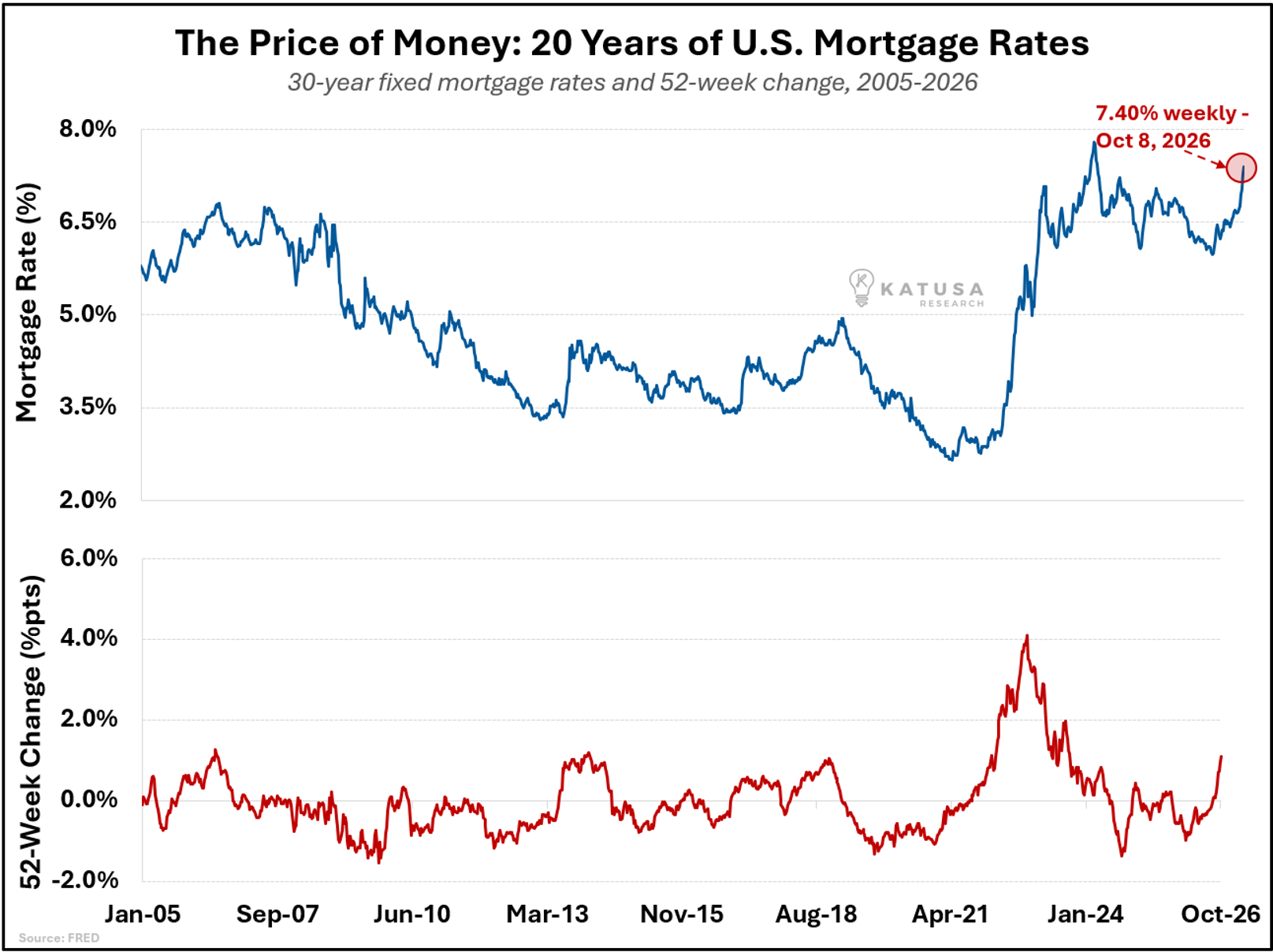
On a $400,000 mortgage, their 3% rate costs about $1,690 a month.
The same loan at today’s 7.40% costs about $2,770… or $13,000 a year more for the same house.
This week the rate on a typical 30-year American mortgage reached 7.40%, the highest in almost three years, and applications fell again.
The same sorting is under way in the resource business, and it will decide who ends up owning the next copper mine.
Who Writes the Next Cheque - The Cost of Capital
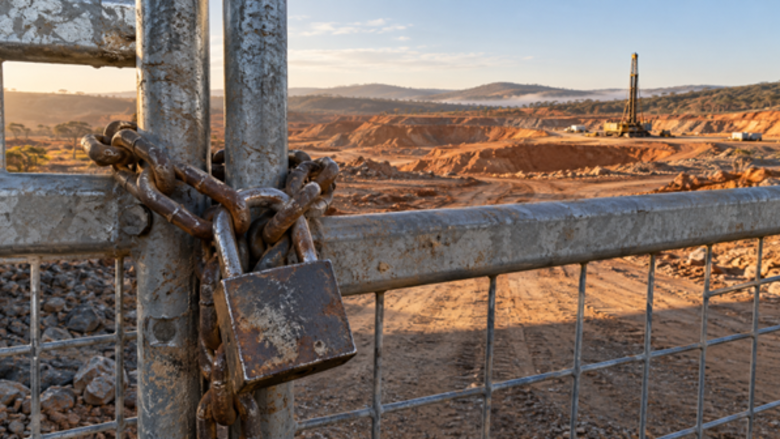
A copper mine can die long before the first tonne comes out of the ground, with the deposit still in place and the demand still growing.
Simply because the money to build it got too expensive.
A company with an operating mine and little debt keeps producing through a rate shock. Its competitor, with a richer deposit and no financing, waits.
Both own copper, and only one of them can sell it.
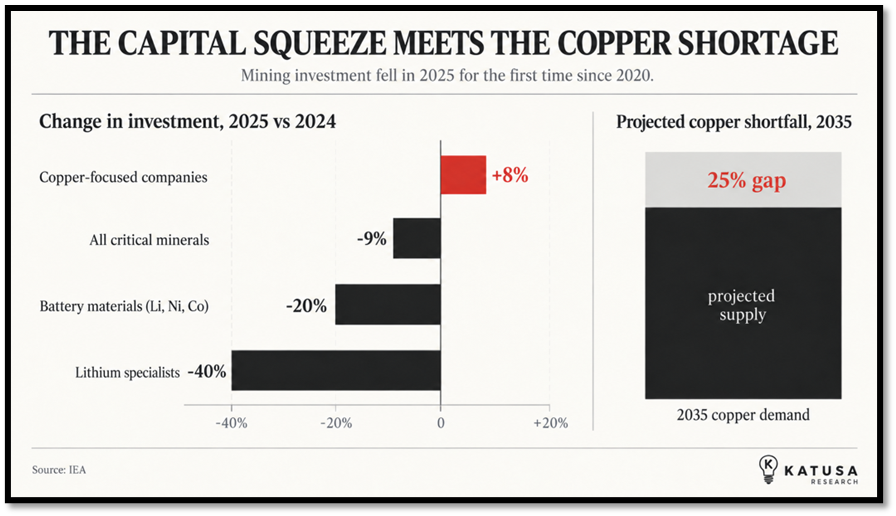
The IEA just said investment in critical minerals fell last year for the first time since the pandemic. Lithium companies cut hardest.
Copper companies were the only group that spent more, and the IEA still expects supply to fall a quarter short of demand a decade from now.
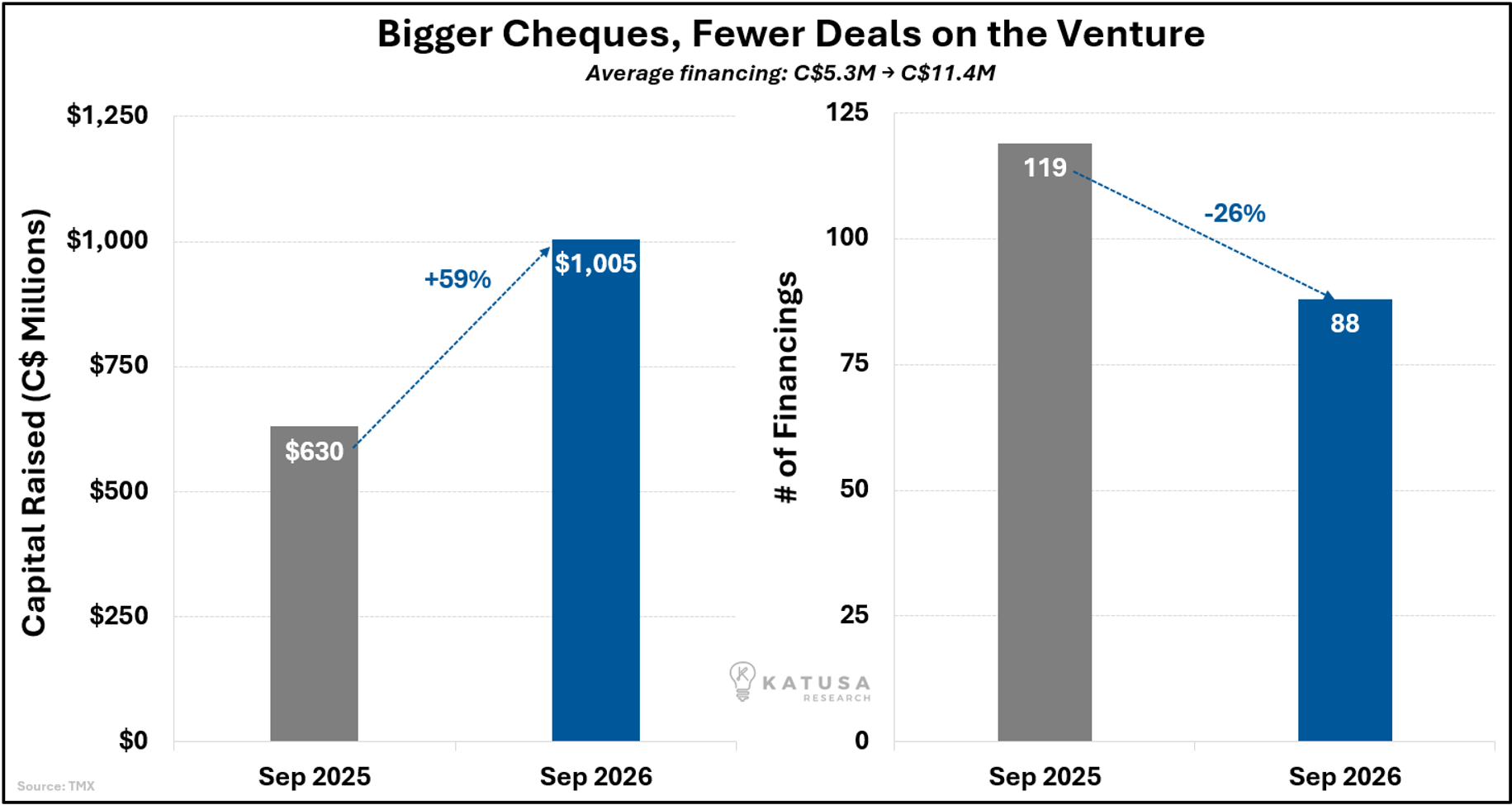
In September, companies on Canada’s Venture exchange raised about a billion Canadian dollars across 88 financings, against C$630 million across 119 financings a year earlier.
- The average cheque more than doubled, from C$5.3 million to C$11.4 million.
- But the exchange now has 91 fewer listed companies than a year ago.
What’s Your Money Worth?
The simple answer, the same as mine.
Back in June 2022, I wrote something in the KRO that still governs every cheque I write:
“My role is not to be liquidity for any company.”
If management wants my capital, they need to give me a compelling reason to part with it.
In September 2023, Enbridge announced the purchase of three U.S. gas utilities and, the same week, sold C$4.6 billion of new shares to help pay for them. The stock sold off.
That month, in my premium newsletter Katusa’s Resource Opportunities, I wrote an issue called "Cost of Capital" and said I was accumulating ENB in size at US$32.90, with the dividend paying out 8.8% at that price.
There were rumors circulating that the company may have to cut their dividend. But we did our homework, believed in our math and I bought in volume… in real time, as did many in the KRO.
Enbridge had the scale to swallow three utilities that almost nobody else could, and decades of contracted cash flow to cover the bill.
- By June 2025, the KRO position was up over 50% and another 21% of our cost base paid out in dividends.
The dividend was the bonus. What we bought was a great business the market had marked down for the size of its cheque.
The Cost of Capital for Enbridge during that acquisition was high. I still own every share of Enbridge because it’s a great company, but knowing when to buy is as important as what to buy.
Last December, the company raised its dividend for the 31st year in a row.
What is Your Price?
Have you ever asked yourself, what is your own cost of capital?
Today, you can earn over 5% on a ten-year Treasury while you wait, with essentially the lowest risk of any alternative on the planet for 5%.
That’s your alternative. 5% for a 10 Year.
- A high-risk venture must be able to deliver multiples of that return considering the high risk.
Do you understand the risk within your own portfolio?
For example, have you properly assessed the time and cost of permitting, exploration, drilling and development? What about metallurgical risk, political risk, cost overruns and commodity prices? And what are the odds the asset is even economic at a commodity price the project can be financed at?
Financial Spectrum
If you have been a long-time reader, you know I have talked about Pareto’s Law in great detail. Some know it as the 80-20 rule.
Here’s a chart that should scare you, regardless of what side of the spectrum you are on.
- 10% of households currently “own” 88.1% of the stock market, up from 82.7% 21 years ago.

The wealth chart above is why this is personal.
The bottom half of American households own 0.6% of the stock market, and the top tenth own nearly nine-tenths of it. The middle 40% own 11.3% of the stock market.
Yes, I am aware that the data is skewed due to founder-held positions such as Elon Musk in both Tesla and SpaceX, and the founder positions in large AI companies are anomalies that add to the data of the top 10%. But the point still holds: Wealth is concentrated.
I’ll give you a real-world current example...
The cost of capital will change depending on what the market offers. Meaning, if one or more of the big AI companies have a hiccup and must hit the markets to meet any cost over runs on a project, the cost of capital will go up (like it did on Enbridge).
A black swan in AI can directly impact on the cost of your favorite gold mine being financed. Do not think they are independent of one another.
Understand, evaluate and expose yourself to the best management teams…
With the best assets in the best jurisdictions that will be able to maneuver any market setbacks.
You also want exposure to balance sheets that can survive downcycles and not dilute your interest and pay you for owning the company.
The couple down the street with the house too big for them with the old mortgage are not rich; their term hasn’t renewed yet with the new cost of capital.
In resources, the deposit tells you what could be built.
The financing to build the project will tell you who will own it.
Regards,
Marin Katusa
Get real-time alerts right away. Follow on X: @KatusaResearch and @MarinKatusa
Details and Disclosures
Investing can have large potential rewards, but it can also have large potential risks. You must be aware of the risks and be willing to accept them in order to invest in financial instruments, including stocks, options, and futures. Katusa Research makes every best effort in adhering to publishing exemptions and securities laws.
By reading this, you agree to all of the following: You understand this to be an expression of opinions and NOT professional advice. You are solely responsible for the use of any content and hold Katusa Research, and all partners, members, and affiliates harmless in any event or claim.
If you purchase anything through a link in this email, you should assume that we have an affiliate relationship with the company providing the product or service that you purchase, and that we will be paid in some way. We recommend that you do your own independent research before purchasing anything.
This is an expression of opinion and not professional advice. Neither Marin Katusa nor Katusa Research are registered broker-dealers or financial advisors. Past performance is not indicative of future results. When investing in speculative stocks, it is possible to lose your entire investment.
© 2026 Katusa Research / New Era Publishing Inc.